
What is retail conversion rate?
Retail conversion rate is the share of visitors who buy. It turns raw footfall into a measure of how well a store actually sells, which is why it sits at the centre of almost every retail performance review. A store with high traffic and low conversion is leaking demand somewhere between the door and the till. A store with modest traffic and strong conversion is making the most of every person who walks in. The metric only does its job when both halves are measured honestly, and the half that retailers get wrong is almost always the visitor count.

The retail conversion rate formula
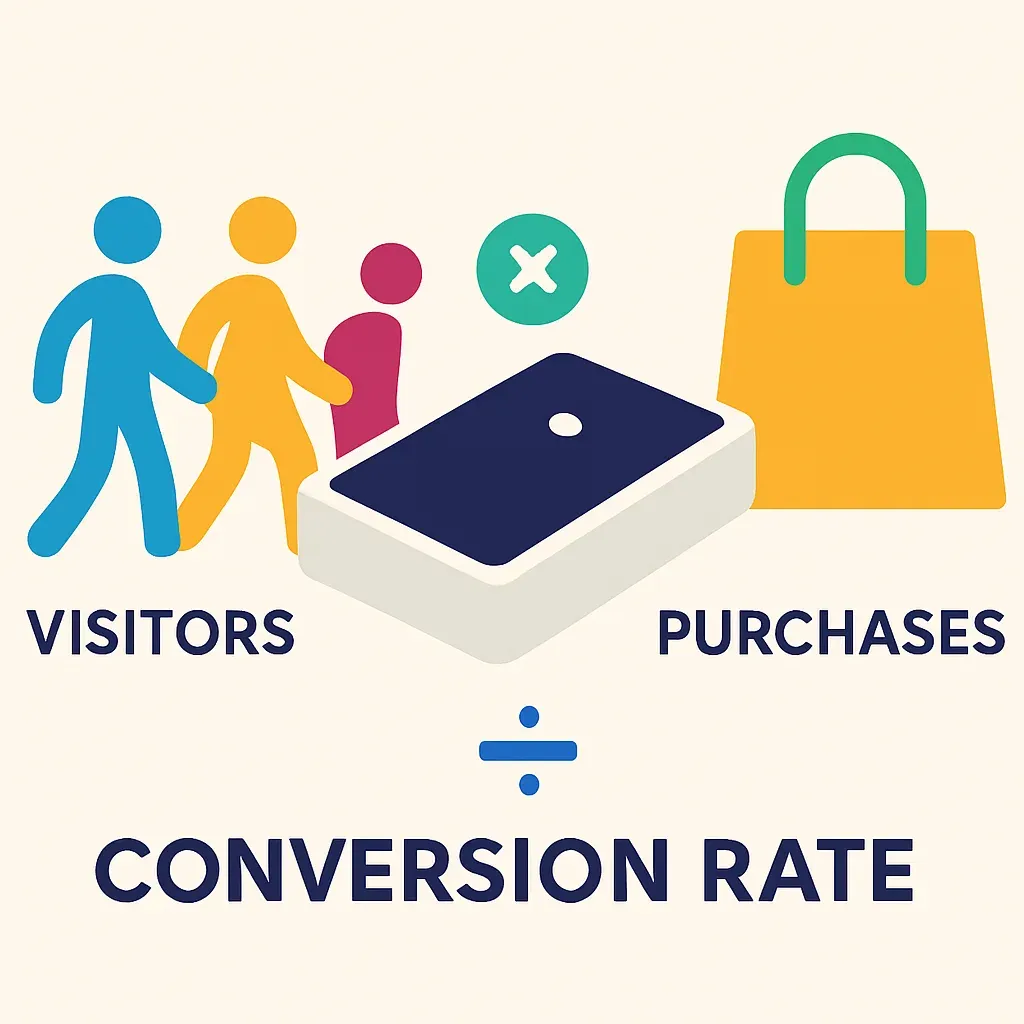
The formula is simple: conversion rate equals transactions divided by visitors, times one hundred.
Conversion rate (%) = (transactions / visitors) x 100
Take a worked illustration with assumptions stated. Assume a single store on a single trading day records 1,200 visitors entering through the door and 180 sales transactions at the till. The conversion rate is 180 divided by 1,200, which is 0.15, times one hundred, so 15 percent. Fifteen out of every hundred people who entered left with a purchase. The arithmetic is trivial. The work is making sure each number means what you think it means.
The numerator, transactions, usually comes straight from the point-of-sale system and is reliable. One transaction is one basket, regardless of how many items it contains. The denominator, visitors, is where conversion rates quietly go wrong, because counting people is harder than counting receipts.
Why the denominator is the hard part
The denominator has to be an accurate count of the people who could have bought: shoppers who entered the store. That sounds obvious, but the most common counting methods do not measure that. They measure something close to it and call it footfall, and the gap between the two distorts every conversion rate built on top.
To be the right denominator, a visitor count has to clear three tests:
- It counts people, not door swings. A count that increments on every passage through the doorway double-counts anyone who steps out and back in, and counts each member of a group as a separate event only if the method can resolve them.
- It counts shoppers, not staff. Employees crossing the entrance to take breaks, restock, or step outside inflate the count with people who were never going to buy.
- It counts entries, not directionless movement. Without a sense of direction, exits get added to entries, so a store that saw 1,200 people enter can report 2,400 movements and halve its apparent conversion rate.
Get the denominator wrong and the conversion rate is wrong in the same proportion, silently. A 15 percent conversion rate built on a count that is 30 percent too high is really closer to 21 percent, and you would be chasing a problem that does not exist. For a deeper treatment of how a clean entry count is defined, see unique visitors versus footfall.
What is a "good" retail conversion rate?
There is no universal good number, and any single benchmark you see quoted should be treated with suspicion. Conversion rate depends on the format, the category, the location, the price point, and what a visit even means for that store. A destination furniture showroom where people browse over weeks converts very differently from a convenience grocer where almost everyone who enters buys. Comparing your rate to a borrowed average tells you almost nothing.
Two comparisons are genuinely useful. The first is your own store against its own history: is conversion trending up or down, and what changed when it moved? The second is your store against comparable stores in your own estate, measured the same way, so a layout or staffing change in one can be read against the others. Both comparisons only hold if every store counts visitors with the same method, on the same definition. The moment one store counts door swings and another counts entries, the comparison is meaningless.
Common mistakes that wreck the conversion rate
Using door swings as the denominator
The most frequent error is treating every passage through the entrance as a visitor. A count that increments on each swing counts exits, re-entries, and staff trips, and the result is a denominator that can be far larger than the real number of shoppers. Because the inflation is invisible in the headline number, the conversion rate just reads low, and stores end up trying to fix a sales problem that is actually a counting problem.
Not excluding staff
In a small store with a handful of employees crossing the threshold dozens of times a day, staff movements can be a meaningful fraction of the count. A worked illustration: assume a boutique records 400 entrance events in a day, of which 60 are staff. Counting all 400 as visitors against 80 transactions gives a 20 percent conversion rate. Counting the real 340 shoppers gives roughly 24 percent. Same sales, four points of difference, entirely from who got counted.
Comparing different visitor definitions
Conversion rates are only comparable when the denominator is defined the same way. If one store counts inward entries and another counts total movements, or one excludes staff and another does not, then ranking the two by conversion rate compares the counting methods, not the stores. This is the quiet killer of estate-wide reporting: the league table looks authoritative and is built on inconsistent denominators.
Confusing conversion with capture
Conversion rate measures buyers among people who entered. Capture rate measures how many passers-by you pulled inside in the first place. They answer different questions, and a store can have strong conversion and weak capture, or the reverse. Mixing them up sends you to the wrong fix. The difference is worth understanding on its own, which the guide to retail capture rate covers in full.
How Ariadne gives a trustworthy denominator
Every problem above traces back to the same root: the visitor count is not a true count of shoppers entering. A conversion rate is only as honest as the number underneath it, so the denominator has to count distinct people, in the inward direction, without staff trips and without re-entries inflating the total.
Ariadne measures this with Hybrid Fusion, its patented camera-free method. Time-of-Flight depth sensing counts every visitor at the entrances, capturing geometry rather than images, while patented phone signal sensing follows movement through the interior, detecting the signals a phone emits even in airplane mode. The sensor streams both feeds to Ariadne, where Hybrid Fusion combines them into one trajectory per visit and computes counts, dwell, and paths. The streams carry no identifier: no MAC address, no device ID, no biometric data, and no camera is involved. Identifiers are stored only when a visitor explicitly opts in, which keeps the method GDPR-friendly and outside biometric territory.
For conversion specifically, the parts that matter are these. Time-of-Flight depth sensing reads the geometry of each body crossing the entrance to roughly 30 centimetres, so it counts people rather than door swings and is directional, separating entries from exits instead of adding them together. The patented phone signal sensing resolves distinct people within a group and follows each visit as a single trajectory, so a family entering together is counted as the several people it is, and a shopper who steps out and back in is recognised as the same visit rather than a fresh entry. Because the streams carry no identifier and no images, the count is identifier-free by design while still being an accurate body count, which is exactly the denominator a conversion rate needs.
Ariadne's people counting produces that entry count, and it feeds the same dashboards that conversion, dwell, and capture sit on, so the denominator is consistent across every store in the estate. For the retail picture end to end, the retail stores solution shows how the count drives staffing, layout, and conversion together.
FAQ
How do you calculate retail conversion rate?
Divide the number of sales transactions by the number of visitors who entered, then multiply by one hundred. 180 transactions against 1,200 visitors is 15 percent. The arithmetic is easy; the accuracy depends entirely on the visitor count being a true entry count.
What is a good retail conversion rate?
There is no universal figure. A good rate is one that is improving against your own history and that compares well against your other stores measured the same way. Borrowed industry averages mislead because format, category, and visit definition vary too much to compare directly.
Should staff be excluded from the visitor count?
Yes. Staff crossing the entrance never had any chance of converting, so counting them inflates the denominator and pushes the conversion rate artificially low. In small stores the effect can move the rate by several points.
Do you need cameras to count visitors accurately?
No. Ariadne counts with Hybrid Fusion: Time-of-Flight depth sensing plus patented phone signal sensing, never cameras. Time-of-Flight captures geometry rather than images, and signal sensing captures no MAC address by default, so the measurement involves no video, no faces, and no biometric data.


