
What does "footfall" actually count?
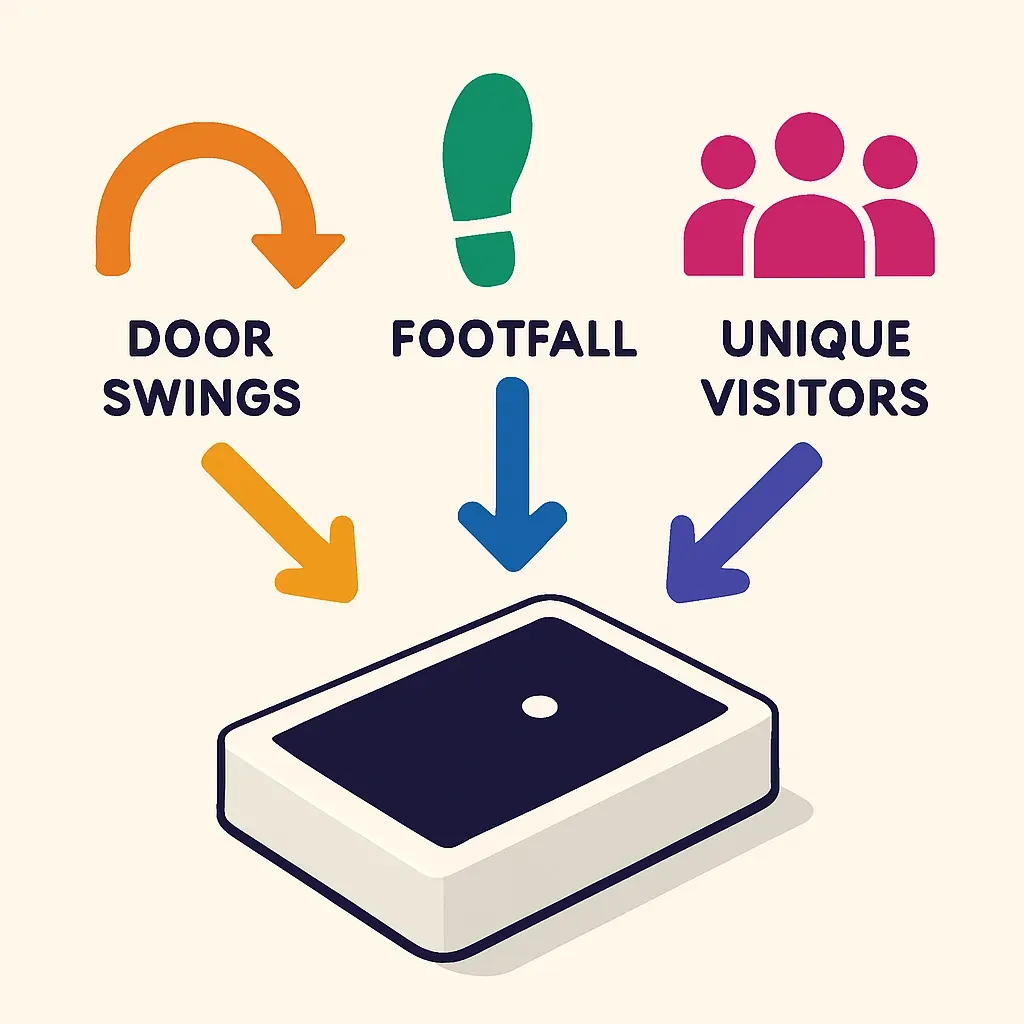
"Footfall" is the most overloaded word in retail and mall reporting. It is used for three different numbers: door swings, entries, and unique visitors. For the same store on the same day those numbers can differ by a factor of two or more, and which one a vendor reports, often without saying so, is the single most common reason a landlord and a tenant comparing notes cannot agree. This glossary defines the three, shows how far they diverge, and states what what Ariadne counts reports for each.
Door swings
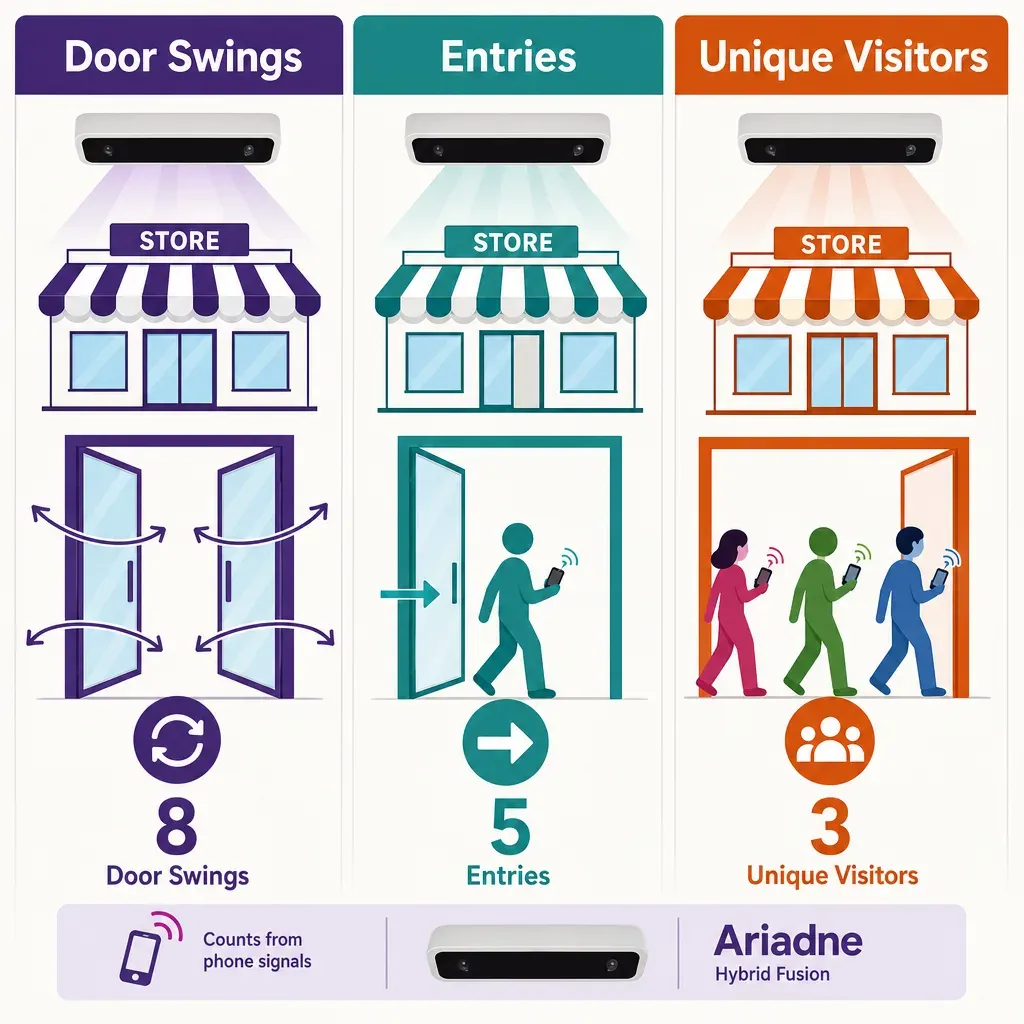
A door swing is a single directional sensor trigger: one person passing the sensor in one direction. It counts movement both ways, into and out of the space. If every visitor enters once and leaves once, door swings come to roughly twice the number of people who actually came in. Door swings are useful for checking that a sensor is alive and for spotting unusual flow, but reported as "footfall" they roughly double the real audience.
Entries
An entry is a directional crossing into the space. Counting entries correctly needs bidirectional counting: add one when a person crosses inward, ignore (or subtract) the outward crossing, so exits and re-entries do not inflate the figure. Entries are what most people mean when they say "footfall", and they are the right denominator for conversion, since conversion is sales divided by people who came in, not by door swings.
Unique visitors
Unique visitors is a deduplicated person count over a chosen time window: if the same person enters three times in a day, they count once. It answers "how many different people", which is the number landlords care about for catchment and reach. Ariadne reports unique visitors without keeping personal identifiers: no MAC address is captured by default, the count reflects presence within the window rather than a stored device ID, and identifiers are kept only when a visitor explicitly opts in. The dedup window matters and should always be disclosed, because a one-hour window and a full-day window produce very different unique-visitor totals.
How the three numbers diverge: one mall door, 8am to 10pm
Take a single mall door over a trading day. Worked illustration, with explicit assumptions: most visitors enter and leave once, and about a quarter come back later in the day. The same sensor data yields three very different headline numbers:
- Door swings: ~10,000. Every inward and outward pass counted.
- Entries: ~5,000. Inward crossings only.
- Unique visitors: ~3,800. Repeat visits collapsed to one person.
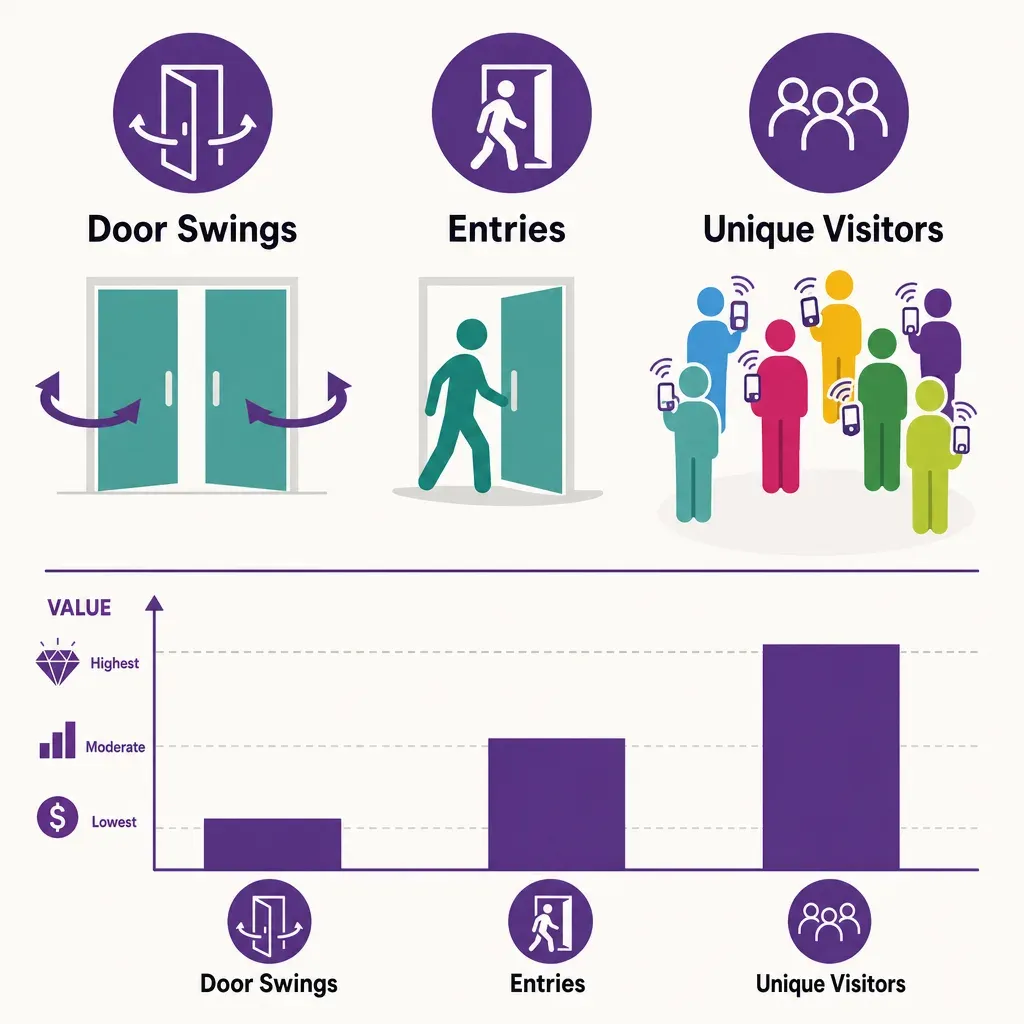
Same door, same day, three numbers, the largest more than two and a half times the smallest. Report door swings as footfall and you look twice as busy as you are; compare your entries against a neighbour's unique visitors and the conversation is meaningless. The numbers are all correct; the label is what is missing.
Which metric do landlords, tenants, and Ariadne use?
- Landlords lean on unique visitors: catchment, reach, and the value of the location.
- Tenants need entries: the honest denominator for their conversion and sales-per-visitor.
- Door swings are operational only, for sensor health and flow, never a headline.
Ariadne reports entries and unique visitors as separate, labelled metrics and never blends them into one undefined "footfall" number. Read alongside a heatmap interpretation, the labelled counts tell you not just how many people, but which definition you are looking at.
Sector conventions
Different sectors default to different members of this family, which is another reason cross-sector comparisons mislead:
- Retail. Entries, because conversion is the operating metric.
- Shopping centres. Both: unique visitors for the landlord narrative, entries for tenant performance.
- Airports. Throughput and entries by zone, since the same traveller passes many sensors.
- Museums and venues. Unique visitors, close to admissions.
- Smart-city pedestrian counters. Directional throughput, closer to door swings, used for flow not audience.
None of these is wrong, but a number is only comparable to another number of the same definition. Treat any unlabelled "footfall" figure, including in retail reporting standards, as undefined until you know which of the three it is.
A 5-question checklist for vendor disclosure
Before you accept any footfall number, ask:
- Which metric is this? Door swings, entries, or unique visitors. If the vendor cannot say, the number is unusable.
- What dedup window defines a unique visitor? An hour, a day, a session? It changes the total.
- Is counting bidirectional or unidirectional? Unidirectional counters cannot separate entries from exits.
- Does it resolve groups? A counter that collapses a family into one understates entries.
- What personal data does it capture, if any? You want identifier-free counting: no faces, no MAC by default, opt-in only.
FAQ
Is footfall the same as the number of customers?
No. "Footfall" usually means entries (people who came in), which is larger than unique visitors (different people) and much smaller than door swings (every directional pass). The number of customers is smaller still, since not every visitor buys.
Why do my footfall numbers not match the mall's?
Almost always because you are comparing different definitions: your entries against the centre's unique visitors, or your bidirectional count against a door-swing total. Agree on one definition and a dedup window before comparing.
Do you need cameras to count unique visitors?
No. Ariadne counts with Hybrid Fusion: Time-of-Flight depth sensing plus patented phone signal sensing, never cameras. Time-of-Flight captures geometry rather than images, and signal sensing captures no MAC address by default, so the measurement involves no video, no faces, and no biometric data.


