
What advertisers actually buy in an airport terminal
Airport advertising looks, on the surface, like the most attractive out-of-home inventory in the market. A captive, affluent, well-travelled audience moves slowly past large screens, with time on their hands and a phone open to whatever distracts them. The booking deck for a campaign at a major hub sells exactly that story. The harder question, the one the brand's media auditor asks six weeks after the campaign ends, is whether the price paid matched the audience actually reached. Answering it cleanly is what airport advertising attribution is for.
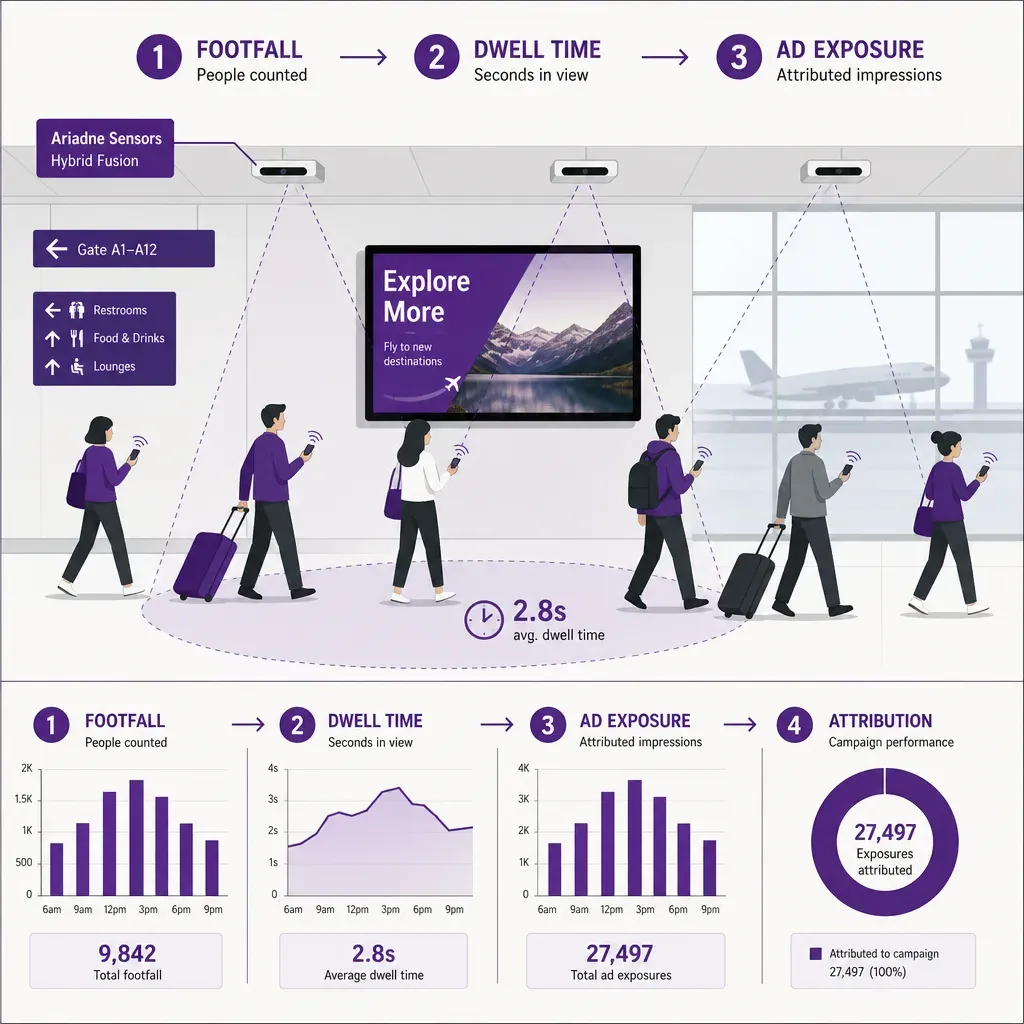
The basic transaction in digital out-of-home, or digital signage, is a screen play: a 10 or 15 second slot that runs in a programmed loop. The price for the play is set against an audience estimate, and that estimate is where the field has historically been weakest. A campaign report lists impressions, plays, and a reach figure, but none of those numbers tells the advertiser how many people in the terminal actually had the opportunity to see the creative, let alone whether the screen was where the audience was at the moment the slot ran. What changes the conversation is connecting the screen log to a live, zoned count of terminal footfall, plus a dwell-weighted view of how long that audience spent inside the screen's visibility cone.
Impressions, plays, and opportunity-to-see
Three figures sit at the centre of every DOOH report, and they are routinely confused with one another in airport sales decks.
- Plays. A play is one airing of the creative on one screen. It is the easiest number to verify, because the screen logs it. It is also the least informative, because nobody may have been in the gate area when the screen played.
- Impressions. An impression is one estimated viewing of the creative by one person. In DOOH the figure is modelled, not counted. The model usually multiplies plays by an audience estimate for the venue and a visibility share. The quality of an impression count is the quality of the audience input behind it.
- Opportunity-to-see, or OTS. OTS is the count of people who passed within the visibility cone of the screen while the creative was playing. It is the figure DOOH industry bodies have pushed the market toward as the cleaner currency, because it separates inventory delivery from creative effect and because it can be measured rather than modelled when there is a real audience sensor in the room.
An airport terminal is the venue type where the gap between plays and OTS is widest. A screen at a satellite gate plays its loop every few minutes for hours when the gate is empty between turns. The play count looks healthy in the report. The OTS sits at zero through those windows and spikes during the 30 to 60 minute boarding wave. A campaign sold on plays is sold on a fiction; a campaign sold on OTS, joined to the boarding schedule, is sold on what the brand is actually buying.
Dwell-weighted reach, not just walk-bys
OTS measured as a head count of walk-bys is a sharp improvement over a flat audience estimate, but it still over-states what an advertiser is buying when the visibility window is short. A traveller cutting straight across a gate area in 12 seconds and a traveller seated facing the screen for 11 minutes both count as one OTS, and the difference between them is most of the value the campaign is paying for.
Dwell-weighted reach is the correction. It multiplies each OTS by the time that person spent inside the visibility cone, capped at the loop length, and reports the result in person-minutes. The same gate area might deliver 9,000 person-minutes during a seated boarding wait and only 80 person-minutes during a turnaround when travellers walk straight through. Plays do not move between those windows; OTS moves a little; dwell-weighted reach moves a lot, and it is the figure that matches what the advertiser actually wants.
Two pieces of input are needed to compute it. First, a count of people inside the visibility cone of the screen over short intervals through the day, broken into zones rather than aggregated to a single terminal figure. Second, the dwell distribution inside that zone, which is what separates the seated boarding wave from the walk-through. Both come from sensors placed against the architecture of the terminal rather than against the screen itself, which is why a DOOH measurement programme is really a terminal people counting programme with the screen log joined to it after the fact.
The retail-side attribution window
Airside retail is the other half of an airport advertising programme, and the attribution methodology there is its own discipline. A screen in the security exit hall pointing travellers at a fragrance concession in the central plaza is sold against three connected claims: that the audience passed the screen, that the audience continued into the concession, and that the visit converted at a measurable lift over the no-exposure baseline. Each claim has its own evidence requirement.
- Exposure. The OTS count from the screen's zone, dwell-weighted, over the campaign window. This is the same figure described above.
- Pass-through. The count of travellers who pass the screen's zone and subsequently enter the concession's entry zone within a defined window, typically 5 to 30 minutes depending on the route. This is the trip-level version of attribution, and it needs a trajectory-level view of the terminal, not just zone counts in isolation.
- Conversion lift. The change in concession transactions or sales for the exposed cohort against the unexposed baseline, controlled for time of day, day of week, flight mix, and any concession-side promotion running in parallel. Conversion lift is the figure the concession's CFO recognises and the figure that justifies the screen's rate card.
The attribution window is the lever that most often gets stretched in a sales conversation. A window of 5 minutes is a strong claim that the screen drove the visit. A window of two hours is honest only if the concession is on the natural route to the gate and the exposure is reinforced by a second screen closer to the door. Brands that audit their airport buys carefully push for shorter windows and tighter control on the baseline. The measurement programme has to be set up to support that, or the attribution figure has no defensible meaning.
The terminal as a measurement venue, not a billboard wall
A clean DOOH attribution programme treats the terminal as a measured venue first and a screen network second. The sensors live against the architecture: at the security exit, at the head of the retail concourse, at the entries to anchor concessions, in each gate hold area. The screen log is a join on top of that measurement layer, not the source of the audience estimate. Setting it up this way has three consequences for the people who run the programme.
- Audience inputs stop being negotiable. The audience figure for each screen zone is whatever the sensor reports, not a number agreed in the contract. Both sides of the buy work from the same count.
- Empty plays are visible. Loop hours that played to an empty gate area show up in the report. Inventory pricing can adjust day-part by day-part rather than running a flat rate against an annual average.
- Concession-side claims become falsifiable. When a screen says it drove footfall to a concession, the trajectory data either supports it or does not. Concession operators can verify a claim before they renew a contract that depends on it, which is the test the airport's commercial team should want to face.
The privacy bar a measurement programme has to clear
Anything attached to advertising in a public venue runs into a separate question, which is whether the measurement itself respects the traveller. Airports sit under a sharper privacy lens than most retail environments, because they handle a captive audience that cannot easily opt out of being in the building. A measurement programme that depends on facial recognition or device-identifier tracking will struggle past a data protection officer, will struggle past a board, and will struggle past the traveller-facing communications team that has to explain it.
Under the GDPR, images of identifiable travellers are personal data and facial recognition produces biometric data, a special category. MAC-address capture from passing phones, where MAC randomisation has not fully eliminated it, raises its own questions about whether a transient identifier is personal data in context. The practical bar most airport measurement programmes apply is simple: the system should report counts, dwell, and trajectories without capturing anything that could identify a traveller. If the answer to that test is honest, the conversation with the airport's data protection officer is short.
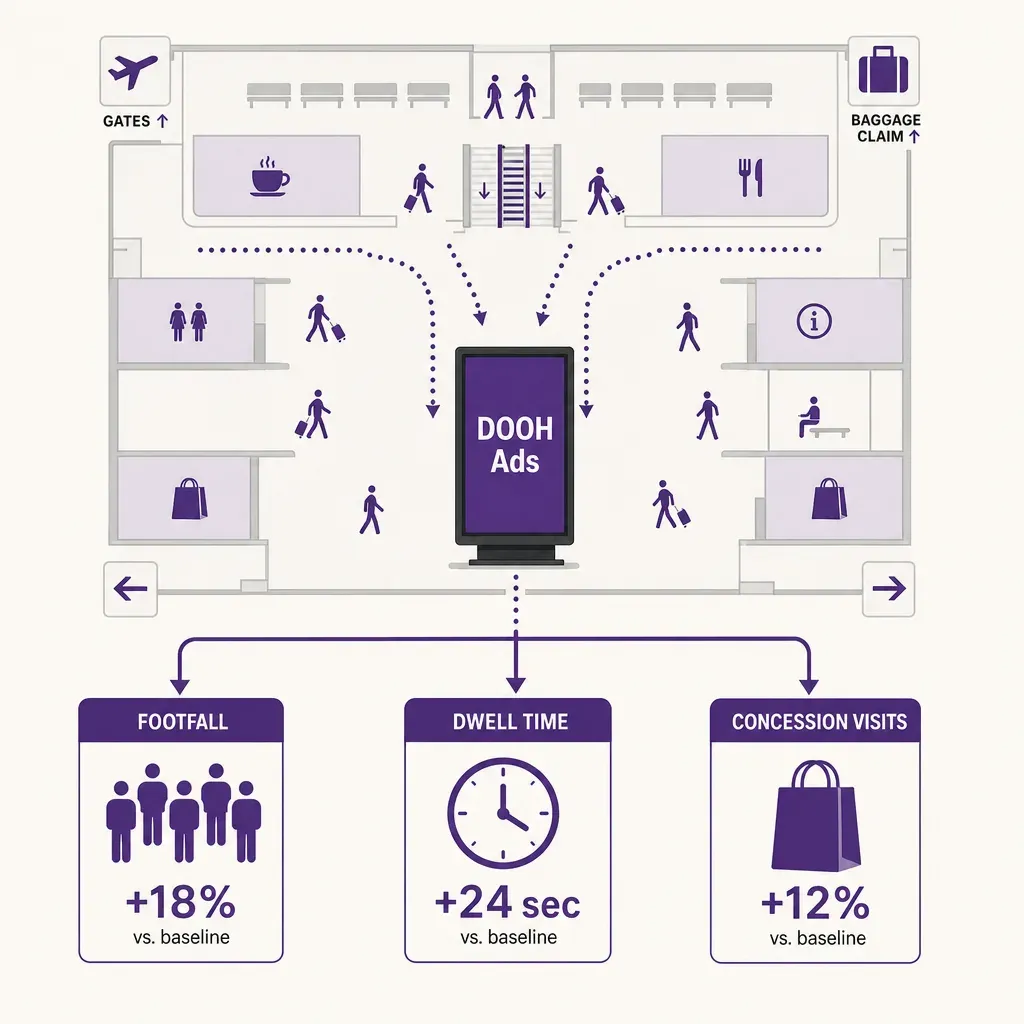
The cleanest way to clear the bar is not to soften a camera feed after the fact, but to choose a method that never captures identifying data in the first place. There is nothing to anonymise later because nothing identifying was collected to begin with.
How Ariadne fits
The two measurement inputs an airport attribution programme needs are an accurate count of travellers inside each screen zone over short intervals, and a trajectory-level view that joins screen zones to concession entries within the attribution window. Both have to be produced without standing up cameras across a public terminal.
Ariadne measures this with Hybrid Fusion, its patented camera-free method. Time-of-Flight depth sensing counts every visitor at the entrances, capturing geometry rather than images, while patented phone signal sensing follows movement through the interior, detecting the signals a phone emits even in airplane mode. The sensor streams both feeds to Ariadne, where Hybrid Fusion combines them into one trajectory per visit and computes counts, dwell, and paths. The streams carry no identifier: no MAC address, no device ID, no biometric data, and no camera is involved. Identifiers are stored only when a visitor explicitly opts in, which keeps the method GDPR-friendly and outside biometric territory.
In an airport advertising context this lands in four practical ways. Zone-level counts at each screen come from Time-of-Flight depth sensing at the entries, which counts every traveller without depending on whether they carry a phone. Group sizing is handled centrally by the patented signal sensing, so a family of four boarding together counts as four exposures rather than as one threshold crossing. Dwell distribution inside the zone separates the seated wait from the walk-through, which is the figure that turns OTS into dwell-weighted reach. The trajectory view supports a clean retail-side attribution window: when a traveller passes a screen zone and subsequently enters a concession entry zone, the journey is observable as one trajectory with no identifier travelling with it. Visitor-marketing tooling on top of that count sits at visitor marketing, and the same measurement layer feeds the wider operational view of an airport terminal. Sensor hardware sits in the Ariadne sensor lineup, and the data handling is set out in the privacy policy.
None of this changes the creative side of an airport DOOH campaign. What it changes is the integrity of the report behind it. A media auditor reviewing the buy sees an OTS figure measured against the actual zone count, a dwell-weighted reach figure that reflects how long the audience was in front of the screen, and a concession-side attribution figure that can be checked against the trajectory data. The campaign either delivered or it did not, and the renewal conversation is faster as a result.
A buyer checklist for advertisers and concession operators
If you are evaluating or auditing an airport DOOH buy, these are the questions worth putting to the media owner in writing.
- Is the audience figure measured or modelled? Ask whether the OTS for each screen zone comes from a sensor in the terminal or from a venue-level audience estimate multiplied by a visibility share. The first is verifiable; the second is a judgement.
- Is reach reported as dwell-weighted? A reach figure in raw OTS counts a walk-through and a seated boarding wait identically. Dwell-weighted reach in person-minutes is the figure that matches what you are paying for.
- How is empty-loop time handled? Plays running into an empty gate area should be visible in the report and reflected in the rate, not averaged into the campaign total.
- What is the retail-side attribution window? Confirm the window length, the baseline period it is compared against, and whether time-of-day, day-of-week, and flight-mix controls are applied.
- Does the measurement capture personal data? The bar to ask for is no images, no faces, no device identifiers by default, with any identifier limited to explicit opt-in. That is the answer the airport's data protection officer will recognise.
- Can the attribution data be audited end to end? Both sides of the buy, the brand and the concession operator, should be able to see the screen log, the zone counts, and the trajectory view that links them. If any layer is opaque, the attribution figure is not defensible.
FAQ
What is the difference between impressions and opportunity-to-see in airport DOOH?
Impressions are usually modelled: plays multiplied by a venue audience estimate and a visibility share. Opportunity-to-see is the count of people who actually passed within the visibility cone of the screen while the creative was playing, measured by sensors in the terminal. In an airport, where audience density varies sharply between boarding waves and quiet periods, an OTS measured from real counts is far closer to what the advertiser is actually buying than a modelled impression figure.
What does dwell-weighted reach add over a basic head count?
Dwell-weighted reach multiplies each OTS by the time that person spent inside the visibility cone, capped at the loop length, and reports the result in person-minutes or person-seconds. It captures the difference between a traveller cutting straight across a gate area in 12 seconds and a traveller seated for 11 minutes, which is most of the value a campaign at a seated gate is paying for. A campaign sold on dwell-weighted reach can defend its rate during boarding windows and discount honestly during quiet hours.
How long should the attribution window be for concession spend?
It depends on the route between the screen and the concession. A screen in the security exit hall pointing travellers at a concession a minute away supports a window of 5 to 15 minutes. A screen further upstream from a concession at the far end of the central plaza needs a longer window, but the longer the window the weaker the causal claim. Most airport advertising buyers push for the shortest window the route physically supports, and ask for a control baseline drawn from the same day-part and flight mix on unexposed periods.
Does the measurement system use cameras at the gates or in the retail concourse?
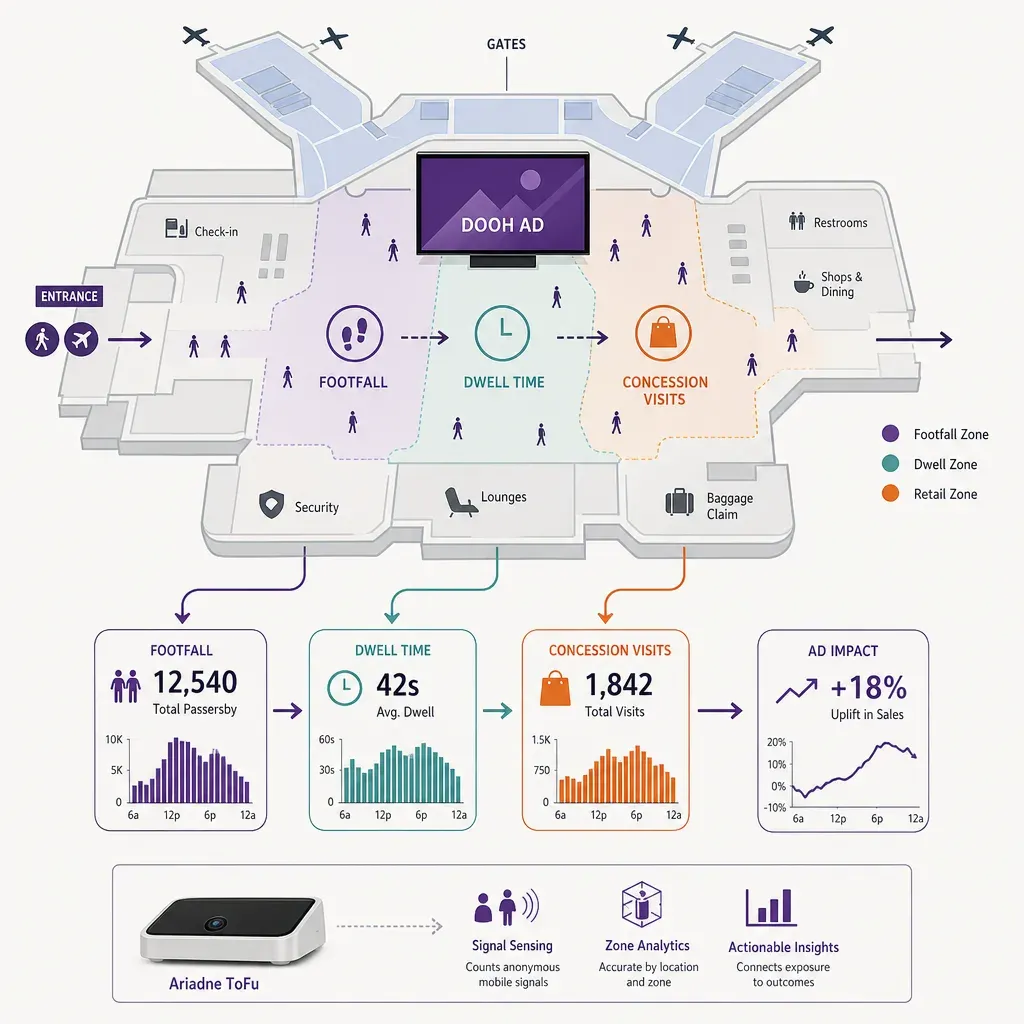
No. Ariadne counts with Hybrid Fusion: Time-of-Flight depth sensing plus patented phone signal sensing, never cameras. Time-of-Flight captures geometry rather than images, and signal sensing captures no MAC address by default, so the measurement involves no video, no faces, and no biometric data.


