
An anchor leaving is the event a centre manager hopes never to handle, and the one most will handle at least once. A department store, a large grocer, or a category-killer format vacates 8,000 to 15,000 square metres in a single move, and the shockwave reaches every lease in the scheme. Footfall drops at the wing the anchor used to feed. Specialty tenants near the dead unit watch their own sales soften. Co-tenancy clauses start to bite, giving smaller tenants the right to cut rent or walk. The vacant box itself, dark and gated, signals decline to every shopper who passes it.
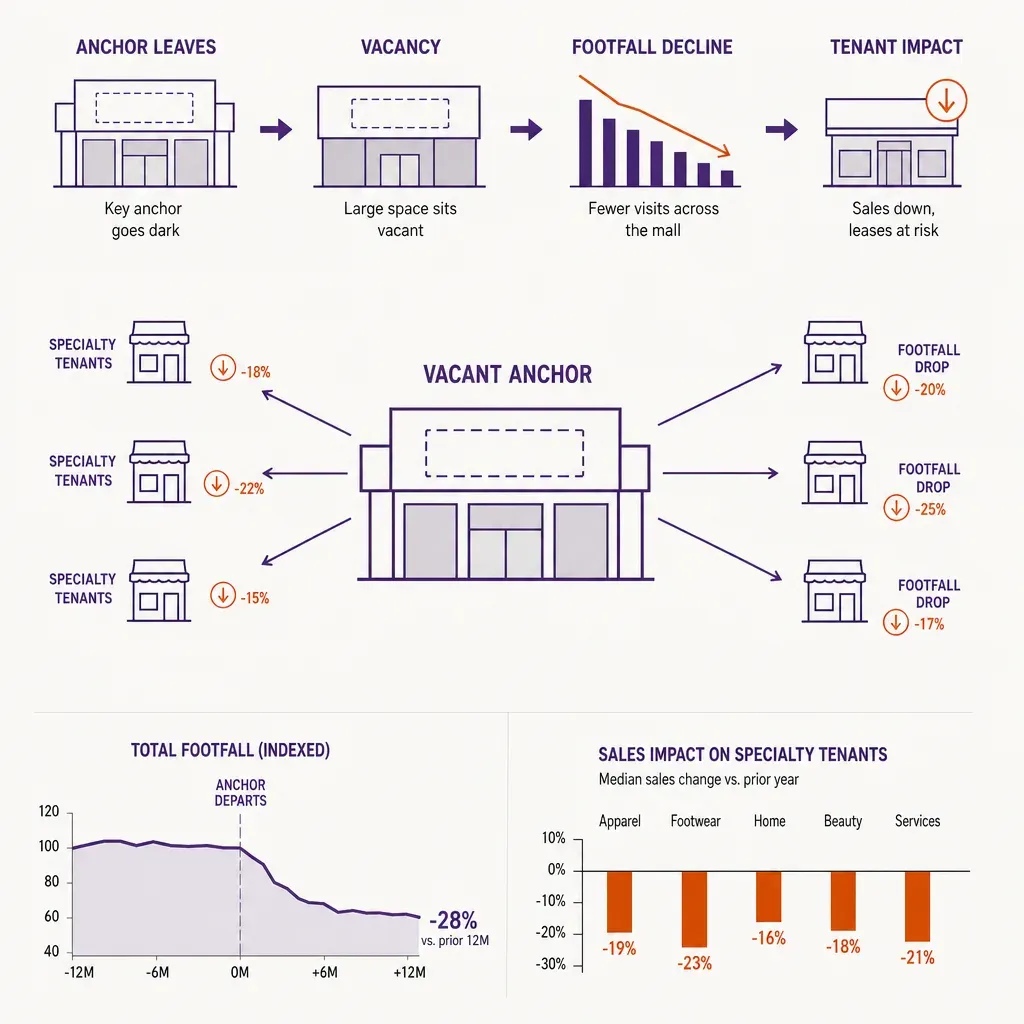
There is no single rescue move. Backfilling an anchor is a sequence of decisions taken over months, sometimes years, and the centres that come through it treat the vacancy as a chance to re-cast the scheme rather than a hole to plug with the nearest available covenant. This is a general, illustrative playbook: seven steps that apply whether you run a regional shopping centre or a mid-size community scheme. The numbers used throughout are examples for clarity, not measured results from any particular site.
Step 1: Assess the hole before you fill it
The first instinct, to find another anchor as fast as possible, is usually the wrong one. Before courting any replacement, you need an honest read of what the departing anchor actually did for the scheme, because that tells you what the box has to do next.
Three questions frame the assessment.
- What was the anchor's draw? Was it a genuine destination that pulled shoppers from a wide catchment, or a tired format that had been coasting on a long lease for years? A department store posting falling sales may have been contributing less footfall than its square metres suggest. The honest version of this question often reveals that the scheme has been over-anchored for a decade.
- Which tenants did it feed? Map the specialty units whose trade depended on traffic walking to and from the anchor. These are the leases most exposed to the vacancy and the ones a co-tenancy clause is most likely to protect.
- What does the box physically allow? Multi-level department-store units, with their internal escalators, loading docks, and column grids, do not subdivide cleanly. The build cost to convert one box into three mid-box units, or into a leisure use with different floor-loading and ventilation needs, sets the floor under every leasing option that follows.
This is where reliable visit data earns its place. A centre that already measures footfall by zone can quantify, rather than guess, how much traffic the anchor wing carried before the departure and how that compares with the rest of the scheme. That baseline becomes the yardstick for everything in step six.
Step 2: Map your co-tenancy exposure
A co-tenancy clause lets a tenant reduce rent, switch to a percentage-of-sales rent, or terminate the lease if a named anchor closes or if scheme-wide occupancy falls below an agreed threshold. The day an anchor announces its exit, these clauses move from dormant contract language to live financial risk, and they can compound the loss of the anchor's own rent several times over.
Before you can plan a replacement, you need a clear inventory of that exposure. Pull every lease in the scheme and mark, for each one:
- The trigger. Does the clause name the departing anchor specifically, name a class of anchor, or hinge on an overall occupancy percentage? A clause tied to a named tenant fires immediately; an occupancy-threshold clause may not fire until vacancies elsewhere stack up.
- The remedy. Reduced fixed rent, a switch to percentage rent, a kick-out right, or some combination. Each carries a very different cost to the scheme's income.
- The cure period. Most clauses give the landlord a window, often 9 to 18 months, to replace the anchor before the remedy becomes permanent. That window is the real deadline driving the whole playbook, not the day the anchor hands back its keys.
The cure period matters more than any other single date. It sets how long you have to sign a qualifying replacement, or a comparable substitute draw, before protected tenants can act on their rights. Reading the playbook backward from that deadline is what keeps the process from drifting.
Step 3: Re-merchandise the whole scheme, not just the box
A vacancy this size is rarely solved by dropping a like-for-like tenant into the same footprint. The retail mix that justified a 12,000 square metre department store in 2005 may not exist as a covenant you can sign in the current market. So the productive move is to step back and ask what the scheme should be, then work out how the empty box serves that, rather than treating the box as a fixed shape that must be matched.
Re-merchandising at scheme level usually means weighing options like:
- Subdivision into mid-box units. Splitting one large box into two or three mid-size units suited to value fashion, homeware, sportswear, or a discount grocer can spread risk and often raises total rent per square metre, at the cost of a heavier fit-out bill.
- A new category of draw. Food and beverage halls, gyms, trampoline parks, climbing centres, and cinemas pull footfall on a different rhythm to retail, filling evenings and weekends. They change dwell time and the trading pattern of the surrounding units.
- Adjacency repair. If the departing anchor sat at a dead end, the replacement strategy should also fix the circulation problem that created the dead end, not just re-let the unit and leave the broken flow in place.
The aim is a scheme that reads as a deliberate mix rather than a collection of whatever leases were available. That reads better to shoppers and underwrites better to investors.
Step 4: Court replacements, including non-retail uses
With a clear view of what the scheme needs, the search for occupiers can begin. The pool is wider than the traditional anchor category, and the centres that recover well are usually the ones that looked beyond it early.
Replacement candidates tend to fall into a few groups.
- Retail anchors that are still expanding. Discount and value formats, large grocers, and some homeware and sportswear brands continue to take big-box space where the rent and catchment work. A single replacement anchor keeps the scheme structurally simple, when one is available on acceptable terms.
- Leisure and experience operators. Cinemas, family entertainment centres, gyms, and food halls trade on visits rather than on a wide product range, and they draw footfall at times retail does not. They typically pay lower rent per square metre but bring traffic that lifts the units around them.
- Non-retail and civic uses. Medical centres, council and government service points, libraries, coworking space, and education providers increasingly take redundant anchor space. They are steady, long-lease occupiers that put reliable daytime footfall through the scheme even if they do not sell anything on site.
- Logistics and last-mile. In some locations a dark store or last-mile fulfilment hub can absorb a back-of-house heavy box, though this adds vehicle movements rather than shopper footfall and should be weighed against the draw the wing needs.
When you pitch a non-retail occupier, footfall and visit data is part of the negotiation. A health provider or a public service tenant wants to know the catchment and the daily traffic the location carries, and a credible visit baseline backs the conversation in a way a brochure cannot.
Step 5: Phase the transition so the scheme keeps trading
An anchor replacement is rarely a clean handover from one tenant to the next. There is usually a gap of months or years between the old anchor leaving and the new use opening, and how that gap is handled decides whether the rest of the scheme holds or slides.
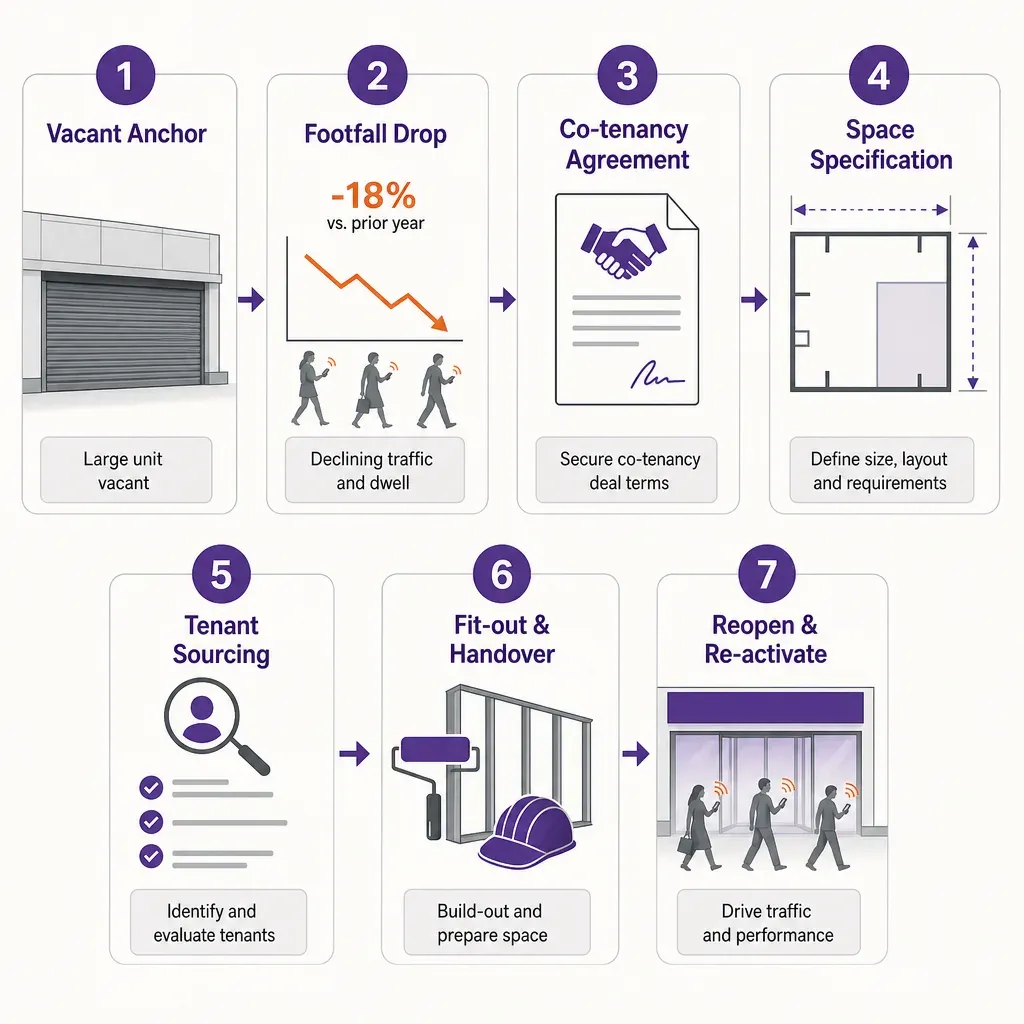
Practical levers during the transition:
- Dress the vacant box. A dark, gated unit reads as decline. Hoarding with the future use, a pop-up, a market, an events space, or a community use keeps the frontage active and the message positive while the deal is finalised.
- Protect circulation. If the empty anchor sat at the end of a mall run, keep that route alive with temporary uses or relocated kiosks so shoppers do not stop walking to that end of the scheme and abandon the specialty tenants there.
- Stage the fit-out. Where a single box becomes several units, opening them in sequence rather than waiting for all to complete returns rent sooner and rebuilds the wing's footfall in steps.
- Use temporary lets deliberately. Seasonal and pop-up tenants generate income and activity during the gap, but the terms should not block the permanent reletting you are working toward.
Step 6: Measure the recovery with footfall data
Re-letting the box is not the finish line. The point of the whole exercise is to restore, and ideally to grow, the traffic and trade the anchor used to support. Without measurement you cannot tell whether the replacement is working, and you cannot show investors or lenders that the scheme has recovered.
Footfall counted by zone, rather than at the main entrances only, is what makes this visible. The metrics worth tracking through and after the transition include:
- Wing-level footfall against the pre-vacancy baseline. Compare traffic in the anchor wing with the level you recorded before the departure, controlling for season and any wider footfall trend across the scheme.
- Cross-shopping between the new use and existing tenants. Whether shoppers who visit the new occupier also walk into the surrounding units tells you if the replacement is feeding the wing the way an anchor should.
- Dwell time and visit patterns. A leisure or food use changes when people come and how long they stay. Tracking dwell and time-of-day patterns shows whether the new draw is doing what you leased it to do.
- Recovery of exposed specialty tenants. The units a co-tenancy clause protected are the ones to watch. If their footfall returns toward the baseline, the case for holding their rent is far stronger than an assertion.
For example, a centre that recorded roughly 4,000 daily visits through the anchor wing before the departure, saw that fall to around 2,600 during the vacancy, and then watched it climb back past 4,000 after a food hall and two mid-box units opened, has an evidence-based story for tenants and investors alike. Those figures are illustrative; the value is in holding the actual numbers, not in the specific values shown here.
The privacy bar for this kind of measurement is high, because shoppers and tenants both expect a centre to count traffic without surveilling individuals. Ariadne measures this with Hybrid Fusion, its patented camera-free method. Time-of-Flight depth sensing counts every visitor at the entrances, capturing geometry rather than images, while patented phone signal sensing follows movement through the interior, detecting the signals a phone emits even in airplane mode. The sensor streams both feeds to Ariadne, where Hybrid Fusion combines them into one trajectory per visit and computes counts, dwell, and paths. The streams carry no identifier: no MAC address, no device ID, no biometric data, and no camera is involved. Identifiers are stored only when a visitor explicitly opts in, which keeps the method GDPR-friendly and outside biometric territory.
In practice that means a centre can report wing-level footfall, dwell time, and cross-shopping to its board and its lenders while a shopper walking the mall is never photographed, recognised, or identified. The counting and fusion run centrally in the Ariadne platform, and the underlying people counting produces the recovery evidence the rest of this step depends on.
Step 7: Communicate to the tenants who stayed
The tenants who remain through an anchor transition carry real anxiety, and they are the ones most likely to invoke a co-tenancy remedy or to decline a renewal if they lose confidence. Managing that relationship is as much a part of the playbook as signing the new occupier.
What good communication looks like:
- Be early and specific. Tenants hear about an anchor departure from the news or from each other if the centre does not tell them first. Get ahead of it with a clear account of the plan and the timeline.
- Share the recovery data. The footfall baseline and the recovery trend from step six are the most persuasive thing you have. Showing a tenant that traffic in their wing is climbing back is worth more than a reassurance.
- Be straight about the gap. Tenants know the box will be dark for a while. Explaining the interim plan, the hoarding, the pop-ups, the staged openings, builds more trust than pretending the gap will be brief.
- Treat exposed tenants individually. The units a co-tenancy clause protects need a direct conversation, not a circular. Aligning on rent and term while the recovery is underway is usually cheaper than letting the clause run to its remedy.
Pulling the playbook together
Backfilling an anchor is a sequence, not a single deal. You assess what the departing anchor actually did, map the co-tenancy exposure that sets your deadline, re-merchandise the scheme rather than the box, court replacements across retail and non-retail uses, phase the transition so the centre keeps trading, measure the recovery with footfall data, and keep the remaining tenants close throughout. The centres that handle a departure well are the ones that treat it as a chance to re-cast the scheme for the next cycle rather than a hole to fill with the nearest covenant.
Reliable, privacy-respecting visit data runs underneath several of these steps: it sizes the hole, supports the pitch to non-retail occupiers, proves the recovery, and gives the remaining tenants a reason to stay. For more on measuring traffic across a centre, see how Ariadne approaches footfall in shopping centres.
FAQ
What is an anchor replacement playbook?
It is the structured sequence a centre follows to backfill a vacant anchor: assessing what the anchor contributed, mapping co-tenancy exposure, re-merchandising the scheme, courting replacement occupiers including non-retail uses, phasing the transition, measuring the footfall recovery, and communicating with the remaining tenants. The aim is to restore the traffic and trade the anchor supported, not just to re-let the box.
How long do you have to replace an anchor?
The practical deadline is usually set by the cure period in your co-tenancy clauses, often somewhere between 9 and 18 months, rather than by the date the anchor vacates. Within that window the landlord typically has to sign a qualifying replacement or a comparable draw before protected tenants can act on a rent reduction or a kick-out right. Read the playbook backward from that date.
Can a non-retail tenant replace a retail anchor?
Yes, and increasingly it does. Gyms, cinemas, food halls, medical centres, public services, libraries, education, and coworking all take redundant anchor space. The test is whether the use brings reliable footfall to the wing and supports the surrounding tenants, not whether it sells products on site. A leisure or civic use often draws traffic at times retail does not.
How do you measure whether an anchor replacement is working?
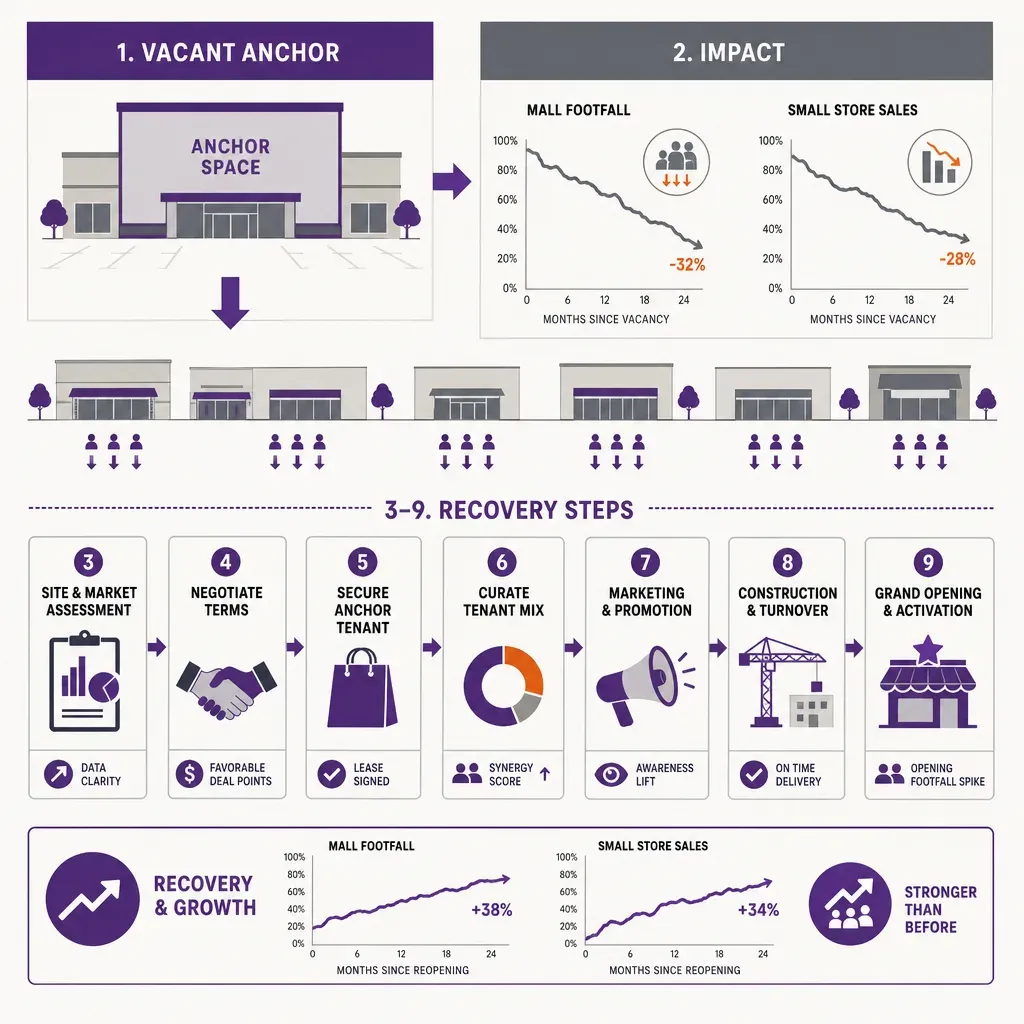
Compare footfall in the anchor wing against the baseline you recorded before the departure, controlling for season and any scheme-wide trend, then track cross-shopping between the new occupier and existing tenants, dwell time, and the recovery of the specialty units a co-tenancy clause protected. Zone-level counting, rather than a single entrance count, is what makes this visible.


