
The hardest question in mall marketing
Every shopping center marketing team is asked the same question, usually by a finance director, sometimes by an asset manager, and always at budget time: did the spend bring people in? A center will run digital ad campaigns into a defined catchment, fund a paid event in the atrium, light up the on-site signage for a tenant takeover, and split media costs with an anchor on a seasonal push. By the end of the quarter, the marketing line on the asset's profit and loss is real, but the link from any single euro of that spend to any single visit through the door is rarely clean.
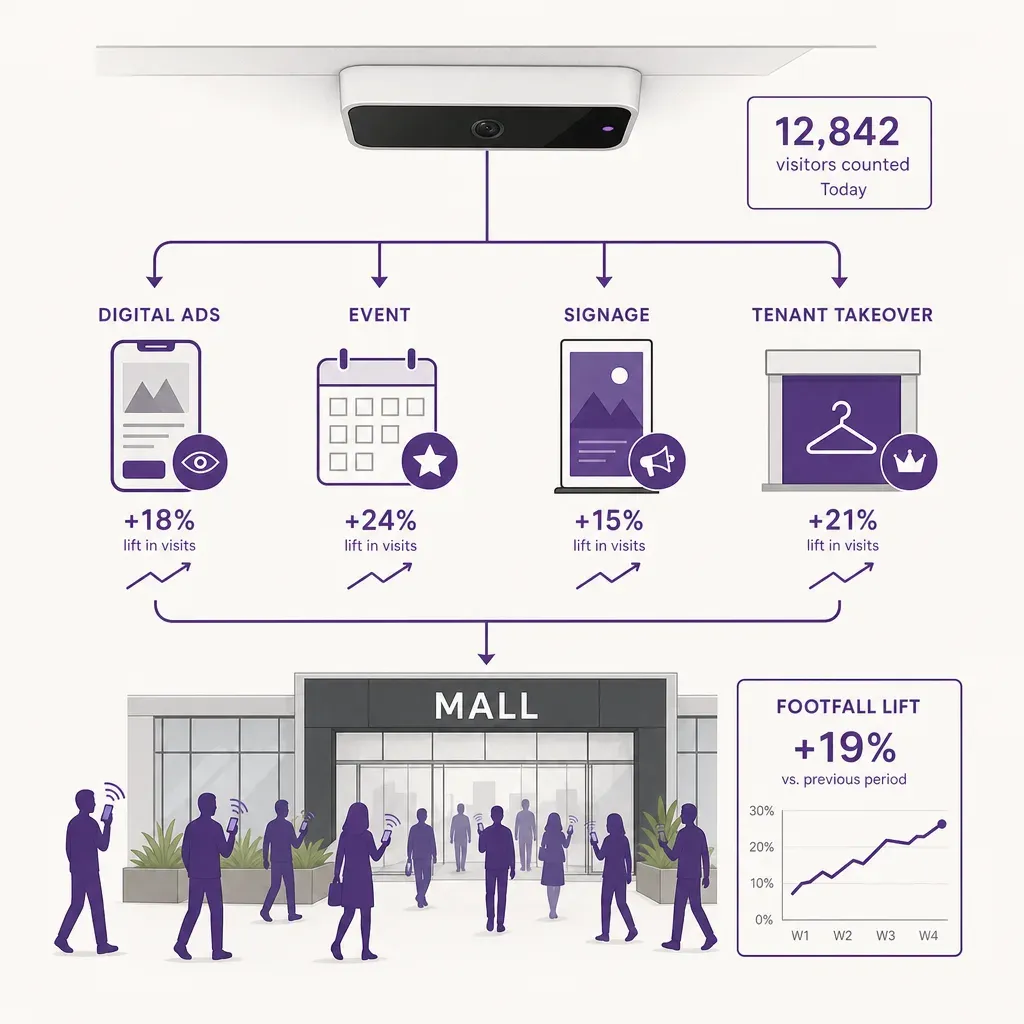
Mall marketing attribution is the discipline of closing that gap. It is the set of methods that take a center's footfall, the only outcome that ultimately matters to a landlord, and divide it into the part that would have happened anyway and the part that the campaign actually caused. This piece walks through the methodology that works in a shopping center, where the baseline comes from, how lift and holdout designs translate from digital advertising into physical retail, and how a visitor-analytics platform like Ariadne's visitor marketing solution supplies the measurement side of the loop without ever knowing who any individual shopper is.
Why last-click attribution does not survive contact with a mall
Digital marketers spent a decade getting comfortable with last-click attribution, where the platform that served the final ad before a checkout earned the credit. That model is already creaky online. In a shopping center, it falls apart entirely.
A visit to a mall is a chain of small decisions that the campaign rarely owns end to end. A shopper sees a paid social post on Tuesday, drives past a billboard on Wednesday, gets a push notification from a tenant's loyalty app on Friday morning, and walks through the door on Saturday afternoon for reasons that include all three of those touches and several that no system saw at all, like the weather, the school calendar, and a friend's text message. No ad platform can claim that visit. No tenant point-of-sale can either. The visit is influenced, not clicked.
Attribution for a shopping center has to start from a different premise: that you cannot follow individual shoppers down a deterministic funnel, and you should not try. What you can do is measure the only number that the center actually owns, total footfall to the property and its zones, and then build a method that can credibly say what share of that footfall was incremental to a campaign and what share would have arrived regardless. That is a population-level question, not an individual-level one, which is both intellectually honest and a much better fit for how shopping centers operate.
Starting with a clean baseline
Every attribution method in this space rests on a baseline: a forecast of what footfall would have been without the campaign. A campaign's lift is then the gap between what actually happened and that counterfactual. The work is in making the baseline credible, because the easier you make it to beat, the more lift you will appear to generate, and the less the number will mean.
Seasonality and day-of-week
A shopping center's footfall has strong, predictable rhythms. Saturdays are not Mondays. The first weekend of the school holidays is not the third. December is not February. A useful baseline strips out those structural patterns by modelling footfall as a function of day-of-week, holiday calendar, school terms, and known retail events, fitted on at least one full year of pre-campaign history. The forecast for any given campaign day is then the value that day would have produced in a non-campaign world.
Weather and the wider catchment
Weather moves mall footfall by double-digit percentages on extreme days, and any honest baseline accounts for it. Temperature, rainfall, and a simple flag for severe weather all belong in the model. So does a control signal from outside the campaign: regional footfall trends, anonymous mobility indices, or comparable centers in the same market. If footfall is up across the region on the day your campaign runs, the campaign cannot claim all of it.
Tenant openings, refurbishments, and other shocks
Baselines also need to acknowledge the structural changes a center actually goes through. A new anchor opening, a major refurbishment closing one wing, the loss of a department store, a transport disruption nearby, these are step changes in traffic, not noise, and they need either to be modelled explicitly or to define the window over which a baseline is built. A baseline that pretends a center is in steady state when it is not will quietly attribute structural shifts to whatever campaign happens to be running.
Once a baseline exists, the lift question is well-defined: given everything else that was going on, was footfall higher during and after the campaign than the model expected, and by how much?
Lift and holdout designs for a shopping center
A baseline forecast on its own is a model, and models can be flattered. The stronger evidence comes from designs that build a control directly into the campaign, so that lift can be measured against something more concrete than a regression line. Three designs are practical in a shopping center context.
Geo holdouts on paid media
If a center buys paid media into a defined catchment, the catchment can usually be split into a treatment region and a holdout region, with the campaign suppressed in the holdout. Footfall is measured from both regions, typically using anonymous mobility data, and the lift is the difference in arrivals between the two. A geo holdout is the closest thing a center has to a randomized control trial for digital advertising. It is harder to set up because suppression costs sales, but for a quarterly seasonal push or a tentpole event, it produces the kind of number a finance director will take seriously.
Pre and post comparisons against a matched window
Not every campaign warrants a holdout. The fallback design is a pre and post comparison against a matched window from a prior year, controlled for seasonality, weather, and known shocks. The center's own historical footfall is the control group. The risk is that something else changed between the windows, so the matched window has to be chosen carefully and the controls applied honestly. Pre and post is weaker than a geo holdout, but for routine campaigns, it is the right tool.
Zone-level controls inside the building
Some campaigns run inside the center itself: an event in the atrium, a tenant takeover in one wing, a pop-up activation in a specific zone. For these, the rest of the center is the natural control. If the activation zone shows a step up in entries on the event days while the other zones move with the centerwide baseline, the activation has caused incremental traffic to its location. If the whole building lifts in step, the activation may have been a draw to the center as a whole, which is a different and equally interesting finding.
All three designs share the same logic: define a control, isolate the campaign, and measure the difference. The control might be a region, a window in time, or a zone in the building, but the structure is the same.
Attribution windows: when does the credit run out?
A campaign's lift does not arrive in a tidy box on the day the spend goes live. A weekend event in the atrium can generate visits the same day, a few in the following week from word of mouth, and a small tail across the month from people who decided to come on a future trip. A digital campaign aimed at a Christmas push will have a peak in the last two weekends before the holiday and a much smaller incremental tail before and after. Attribution windows define how long after a campaign you continue counting incremental footfall as caused by it.
There is no single right window. There is a right approach, which is to declare the window in advance, justify it from the campaign's nature, and apply it consistently across campaigns of the same type. A simple working framework:
- Same-day or weekend events. Count incremental footfall on the event day and the immediately following day. Beyond that, attribution decays fast and the noise overwhelms the signal.
- On-site signage and tenant takeovers. Count incremental traffic for the duration of the campaign window plus one week of carryover.
- Paid digital into the catchment. A two to four week window from first impression, depending on the message. Brand campaigns decay slowly; price-led campaigns decay quickly.
- Partner and co-marketing campaigns with anchors. The same window as the underlying campaign, with the partner's contribution split out as part of the lift analysis rather than double-counted.
Declaring the window in advance is the integrity step. Pulling the window forward or backward once the data is in is how attribution starts to flatter itself.
Putting numbers on the cost of a visit
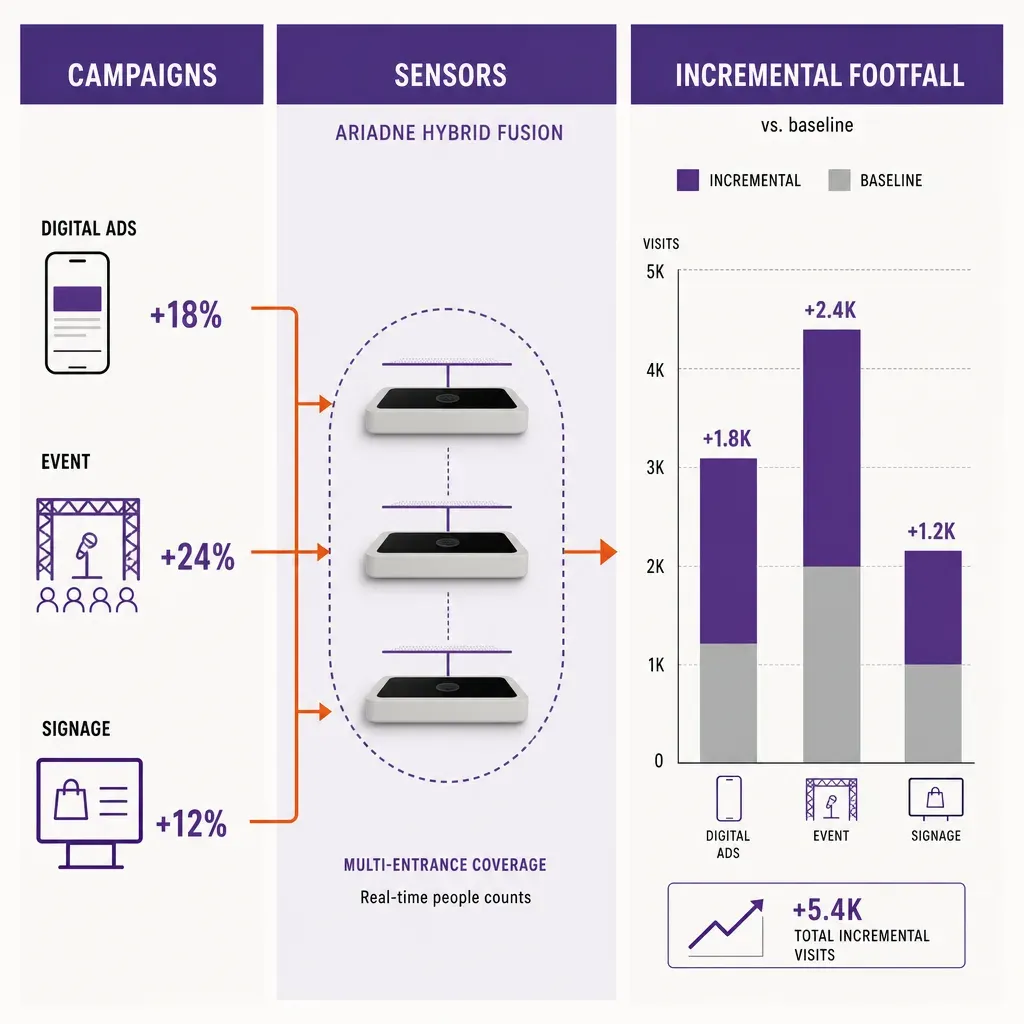
Once incremental footfall is in hand, the next question is what each incremental visit cost. Divide campaign spend by the incremental visits the campaign produced, and you have a cost-per-incremental-visit (CPIV) that a center can compare across channels and across quarters.
For example, a center seeing 200,000 monthly visits might run a paid social campaign over four weekends, spend a defined media budget, and measure 8,500 incremental visits against a holdout. The CPIV for that campaign is the budget divided by 8,500. The same calculation, run on a paid event in the atrium with a different cost structure, gives a comparable number for in-person activation. These figures are illustrative; the value is the method, not the magnitudes. What CPIV gives a center is the first apples-to-apples comparison of marketing channels that the asset has ever had.
CPIV alone is not the answer, because not every visit is worth the same. A visit on a quiet Tuesday is more valuable to the center than a visit on a queue-limited peak Saturday, because the marginal sale from a quiet-day visit is real and the peak-day visitor was probably going to come anyway. Layering visit value on top, using tenant sales data where available, basket size assumptions, or even simple weighting by day-part, turns CPIV into a return-on-incremental-visit calculation that finance teams can take into the next budget round.
Where the measurement comes from
All of this depends on a footfall measurement that the center actually controls and trusts. Marketing attribution that runs on a tenant's loyalty data is hostage to that tenant. Attribution that runs on an anonymous mobility index is useful for catchment context, but it is too coarse to power a zone-level analysis. The measurement that fits this work is one the center owns end to end: continuous, accurate, broken down to the zone, and produced in a way that does not depend on shoppers being individually identified.
Ariadne measures this with Hybrid Fusion, its patented camera-free method. Time-of-Flight depth sensing counts every visitor at the entrances, capturing geometry rather than images, while patented phone signal sensing follows movement through the interior, detecting the signals a phone emits even in airplane mode. The sensor streams both feeds to Ariadne, where Hybrid Fusion combines them into one trajectory per visit and computes counts, dwell, and paths. The streams carry no identifier: no MAC address, no device ID, no biometric data, and no camera is involved. Identifiers are stored only when a visitor explicitly opts in, which keeps the method GDPR-friendly and outside biometric territory.
For a marketing team, the practical consequence is that the footfall feed behind every attribution calculation is solid: entry counts at every door, live and historical, by hour and by day; dwell time and visit length; zone-to-zone flow inside the building; and group sizing for visits, which matters because two adults arriving together are one decision, not two. Because the streams carry no MAC address by default and no device identifier, the data is not personal data, which keeps the analysis on the right side of the GDPR and well clear of biometric territory.
Where Ariadne fits in the attribution loop
Ariadne sits on the measurement side of mall marketing attribution. It is not an ad platform, it does not buy media, and it does not see who any shopper is. What it does is supply the footfall and dwell data that lift, holdout, and pre-post designs require, in a form a marketing team can pull into the same dashboard as its media spend.
- Center-level and zone-level counts. Entries by door and by zone, in real time and as historical series, with the resolution needed to credit a campaign to the location it ran in.
- Dwell and flow. Average and distribution of visit length, plus zone-to-zone movement, so a campaign that lengthens the average visit is captured as well as one that brings more visits.
- Group sizing without identifiers. Ariadne's patented signal sensing distinguishes individuals in a group without recording who anyone is, which means a family of four counts as four visits with one decision behind them. That detail matters for both campaign measurement and venue-side planning.
- Exports into the marketing stack. Ariadne Analytics exports clean time-series footfall and dwell that a marketing team can pull alongside campaign spend in whatever stack already runs the asset.
For centers that already have Wi-Fi access points and people-counting sensors in place, EaseLink feeds the same analytics dashboard from existing infrastructure, with no new sensors on the ceiling. The point of the integration is that the center can measure attribution against a footfall feed it owns, regardless of which hardware the building was originally built with. The combination, people counting at the doors and zones plus EaseLink across existing hardware, is what makes attribution work for a shopping center without forcing a rip-and-replace project.
A practical attribution workflow
Pulling all of this together, a marketing team running a mall marketing attribution programme tends to settle into a workflow that looks like the following. It is not glamorous, but the discipline is what makes the numbers defensible.
- Define the campaign and its hypothesis. Write down what the campaign is meant to do, which zones or channels it will use, the spend, and the dates. The hypothesis is the lift you would consider a success.
- Lock the baseline and the attribution window before the campaign runs. Decide the control (geo holdout, matched window, or zone-level), the model for the baseline forecast, and the window over which incremental footfall will be counted.
- Capture footfall continuously. Make sure the measurement that will feed the lift analysis is operating cleanly across the campaign window and the comparison window. A sensor outage during the test invalidates the test.
- Run the lift calculation on the declared design. Compute incremental footfall against the baseline or the holdout, not a metric chosen after the fact. Apply the same approach next quarter so campaigns are comparable.
- Translate footfall into CPIV and value. Divide spend by incremental visits for cost-per-incremental-visit. Layer visit value on top using whatever sales data is available, even at a coarse level, to turn the figure into a return calculation.
- Review what the next campaign should change. The point of attribution is not to grade campaigns retrospectively; it is to inform what to do next. End every analysis with the decision it implies for the next budget cycle.
What honest attribution looks like
Two patterns separate the centers that run mall marketing attribution well from the ones that run a polished version of guesswork. The first is that the strong centers declare their methods before the campaign runs and live with the answer, even when the answer is unflattering. A holdout that shows little lift is still a finding. The second is that they treat attribution as a tool for the next decision, not a scorecard for the last one. The point of measuring incremental footfall against spend is to underwrite the next quarter's plan, not to relitigate what already happened.
Either way, the work depends on a footfall feed the center owns and trusts. Get the measurement right, define the baseline and the window before the campaign goes live, and choose a design with a real control where the budget justifies it. Do that consistently and a center moves from arguing about marketing in adjectives to discussing it in numbers, which is most of what a credible attribution programme has to deliver.
FAQ
What is mall marketing attribution?
Mall marketing attribution is the set of methods that link a shopping center's marketing spend, including digital ads, on-site signage, paid events, and partner campaigns, to incremental footfall through the doors and into the zones. Rather than crediting individual shoppers to individual ads, it estimates what share of total footfall was caused by a campaign against a baseline of what would have happened anyway.
How do you build a baseline for mall footfall?
A useful baseline models a center's footfall as a function of day-of-week, holiday and school calendars, weather, and known structural events like a tenant opening or a refurbishment, fitted on at least a full year of pre-campaign history. The baseline forecast for any given campaign day is what the model predicts in a non-campaign world; lift is the gap between that and what actually happened.
What is a geo holdout in a shopping center context?
A geo holdout splits a center's catchment into a treatment region, where the campaign runs, and a holdout region, where the campaign is suppressed. Footfall is measured from both, typically through anonymous mobility data, and the lift is the difference in arrivals between the two regions. It is the closest thing a center has to a randomized control trial for paid media and produces the strongest evidence of incremental impact.
How long should an attribution window be?
Set the window in advance and base it on the campaign type. Same-day events typically use a one to two day window, on-site signage and tenant takeovers use the campaign duration plus about a week of carryover, and paid digital uses a two to four week window from first impression, with brand campaigns decaying more slowly than price-led ones. The discipline is to declare the window before the campaign runs and apply it consistently.
Does footfall measurement for attribution use cameras?
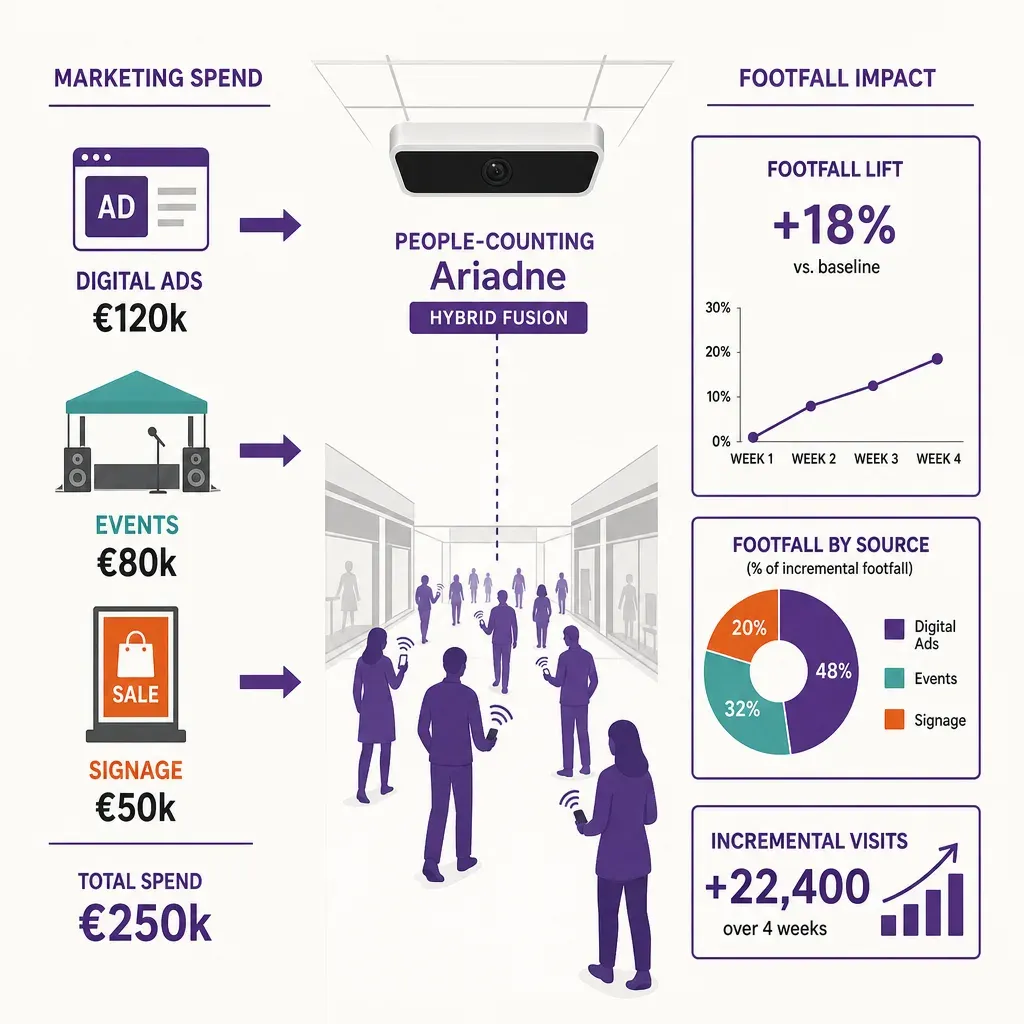
No. Ariadne counts with Hybrid Fusion: Time-of-Flight depth sensing plus patented phone signal sensing, never cameras. Time-of-Flight captures geometry rather than images, and signal sensing captures no MAC address by default, so the measurement involves no video, no faces, and no biometric data.


