
Why museums count footfall
A large museum is a building with several conflicting pressures running at once. Curators want to know which exhibitions earn their floor space. The operations team needs to keep galleries within their safe capacity on a busy weekend. Funders and grant bodies want attendance figures they can audit. Visitor services want to plan staffing without guessing. All of that runs on one underlying number: how many people are in the building, and where they spend their time. For an institution over 10,000 square metres, you cannot answer that with a clicker at the door and a tally sheet. You need a people counting system that reports continuously and breaks the building down by gallery and zone.
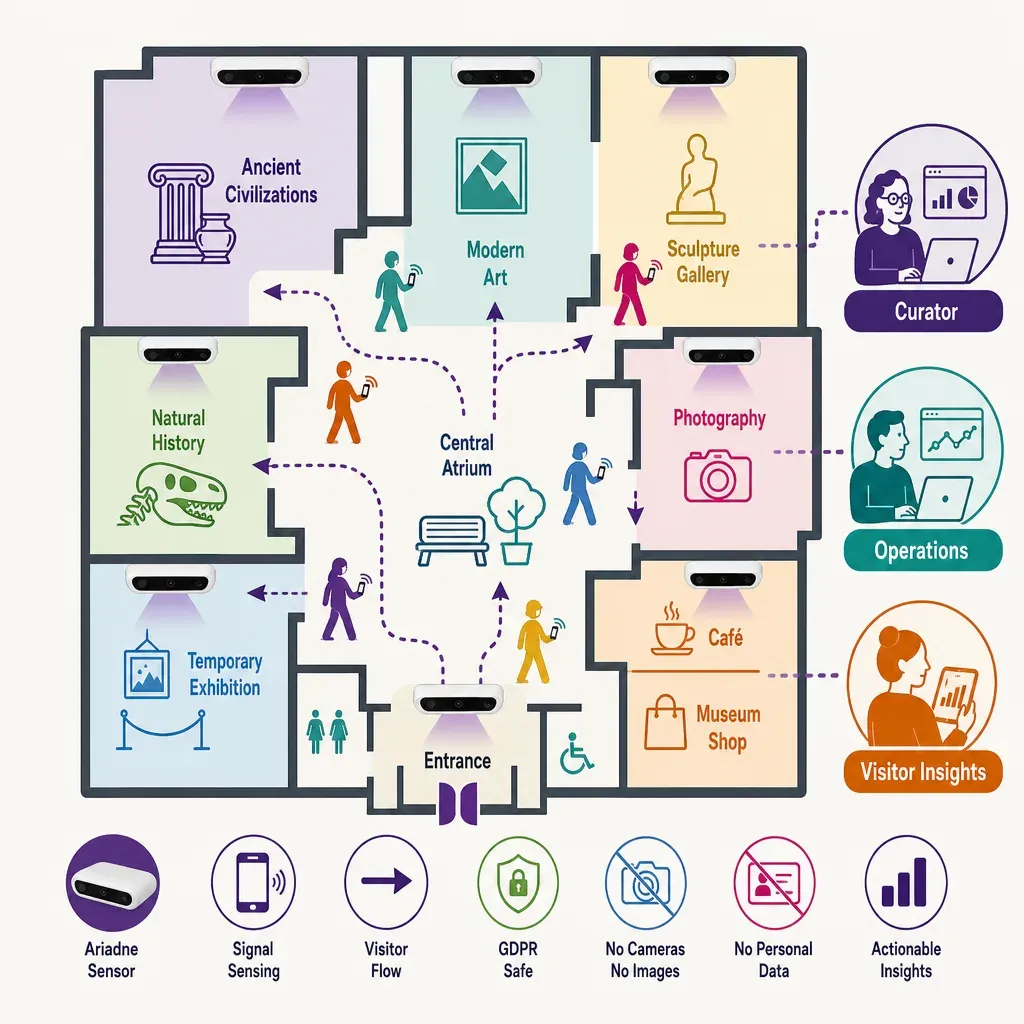
Cultural institutions tend to need footfall data for four reasons, and each one asks something slightly different of the counting system.
Capacity and safety
A blockbuster exhibition or a free-entry weekend can push a popular gallery past comfortable capacity. Live occupancy lets the operations team see when a space is filling, slow the queue at the entrance, or open an overflow route before crowding becomes a safety issue. Occupancy is also the basis for any emergency planning that depends on knowing how many people are inside a wing at a given moment.
Exhibition and gallery performance
Floor space inside a museum is finite and expensive. When a temporary exhibition closes, the question is whether it justified the gallery it occupied and the install cost behind it. Per-gallery counts answer that directly: how many visitors entered the space, how that compared with the permanent collection nearby, and how attendance moved across the run of the show.
Dwell time by zone
A raw entry count tells you a gallery was busy. It does not tell you whether people stayed. Dwell time, the average length of time a visitor spends in a zone, separates a gallery that people walk through from one that genuinely holds attention. That distinction matters for curatorial decisions, for sponsor reporting, and for working out which routes through the building are underused.
Funding and grant reporting
Public funding, sponsorship, and grant applications usually carry an attendance obligation. The figures have to be defensible, not estimated. A counting system that produces continuous, exportable attendance and occupancy data gives the finance and development teams numbers they can put in front of a funder without caveats.
The privacy expectations of cultural institutions
Museums sit under a higher privacy bar than most commercial buildings, and they hold themselves there for reasons that go beyond compliance. A cultural institution is a place the public trusts. Anything that feels like surveillance, a visible camera array trained on visitors, a system that recognises faces, a sense of being tracked through the building, sits badly against that trust, even where it would be technically lawful.
Under the GDPR, the bar is concrete. Images of identifiable visitors are personal data. Facial recognition produces biometric data, a special category that needs a strong legal basis and is hard to justify for headcounts. Many museums are also public bodies or charities with their own data protection commitments and a board that will ask hard questions about any new sensor. The practical test most institutions apply is simple: does the system capture anything that could identify a visitor? If the honest answer is no, the conversation with the data protection officer is short.
The cleanest way to clear that bar is not to soften a camera feed after the fact, but to choose a method that never captures identifying data in the first place. There is nothing to anonymise later because nothing identifying was collected to begin with.
What camera-free counting looks like
Camera-free counting measures people without forming an image of them. Two sensing methods do this well, and a serious system for a large museum tends to combine them.
- Time-of-Flight depth sensing at entries. A ceiling-mounted sensor fires infrared pulses and measures how long they take to return, which gives the height and shape of whatever passes below it to roughly 30 centimetres. It counts every visitor crossing the threshold, independent of whether they carry a phone, and it reads geometry rather than images. There is no picture to store and nothing to recognise.
- Phone signal sensing in the interior. Inside the galleries, sensors detect the radio signals a phone emits, even in airplane mode, and triangulate position. This resolves distinct individuals and measures how long they linger in a zone, without recording who they are.
Neither method uses a camera, and neither produces video, faces, or biometric data. That is the property that matters to a museum: the system can report exactly how busy a gallery is and how long people stay, while a visitor walking through it is never photographed, recognised, or identified.
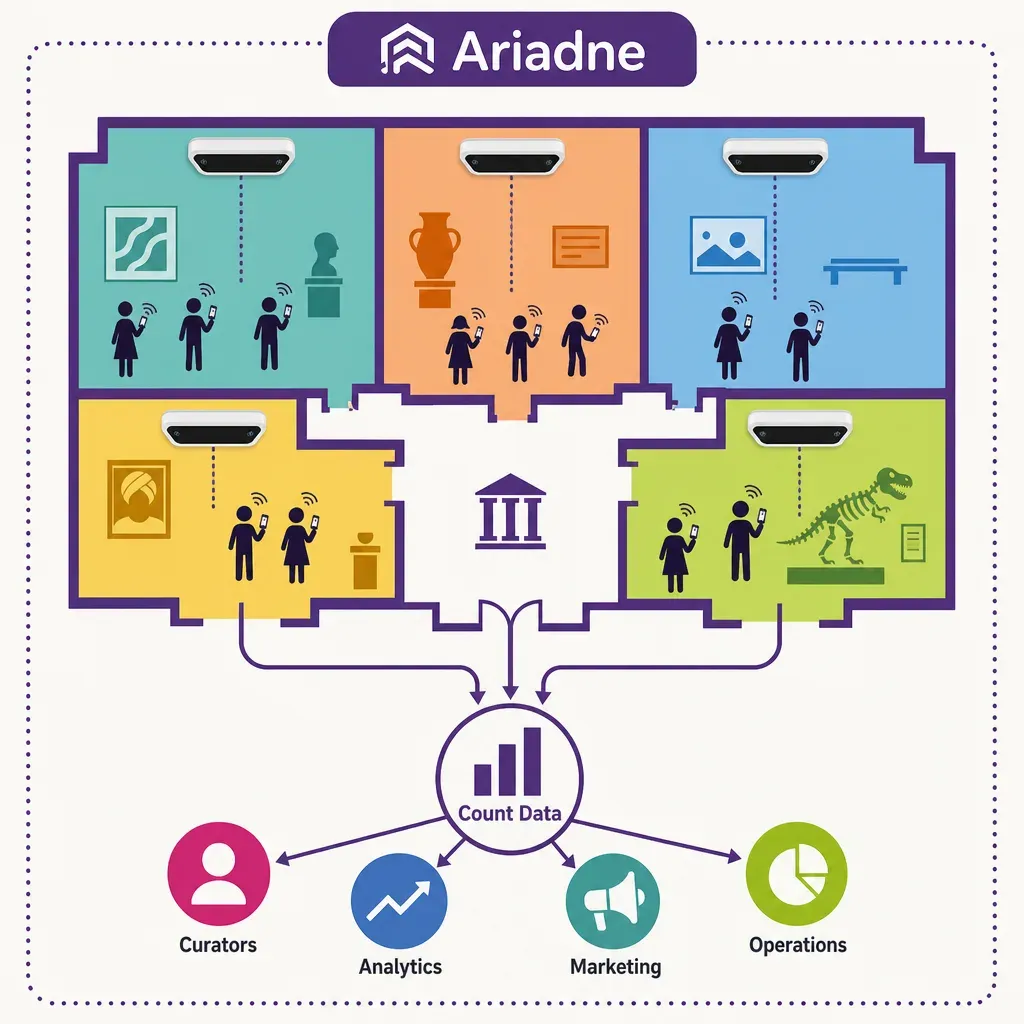
Per-gallery and per-zone counting and dwell
A single entrance count is the floor of what a large museum needs. The value is in the breakdown by space. With sensors placed across the building, you can treat each gallery, wing, or temporary exhibition as its own counting zone and read three things for each one:
- Entries. How many visitors came into the zone over any chosen period.
- Live occupancy. How many people are in the zone right now, which is the figure the operations team watches against a safe-capacity limit.
- Dwell time. How long, on average, a visitor stays, which separates a gallery people pass through from one that holds them.
Put those zones together and you get a flow picture of the whole building: where visitors enter, which routes they take, which galleries pull traffic and which sit quiet, and where bottlenecks form on a busy day. That is the data a curator uses to judge an exhibition, an operations manager uses to manage capacity, and a development team uses to report attendance with confidence. Some of this maps onto wider work on visitor flow in public spaces, where the same camera-free principles apply at larger scale.
How Ariadne fits
Ariadne builds the two sensing methods above into one system, designed so that nothing identifying is captured at any point.
Ariadne measures this with Hybrid Fusion, its patented camera-free method. Time-of-Flight depth sensing counts every visitor at the entrances, capturing geometry rather than images, while patented phone signal sensing follows movement through the interior, detecting the signals a phone emits even in airplane mode. The sensor streams both feeds to Ariadne, where Hybrid Fusion combines them into one trajectory per visit and computes counts, dwell, and paths. The streams carry no identifier: no MAC address, no device ID, no biometric data, and no camera is involved. Identifiers are stored only when a visitor explicitly opts in, which keeps the method GDPR-friendly and outside biometric territory.
For a museum, the practical consequences line up with the privacy bar described earlier. There is no camera and no video, so there is no image of a visitor to store or to lose. The streams carry no MAC address by default and no device identifier, so there is no personal data in the count. Identifiers are stored only when a visitor explicitly opts in, for example by logging into guest Wi-Fi, which is a choice the institution can simply decline to offer. The result is per-gallery counts, live occupancy, and dwell time across a building over 10,000 square metres, produced without anything that a data protection officer would classify as personal data. The sensor hardware sits in the Ariadne sensor lineup, and the data handling is set out in the privacy policy.
A buyer checklist for institutions
If you are evaluating a footfall system for a large cultural institution, these are the questions worth putting to any vendor in writing before a trial.
- Does it capture any personal data? Ask whether the system records images, faces, MAC addresses, or device identifiers. You want a clear no by default, with any identifier limited to explicit opt-in.
- Is there a camera anywhere in the path? A method built on Time-of-Flight depth and signal sensing avoids cameras entirely, which is the cleanest answer to give a board or a data protection officer.
- Can it report per gallery, not just per door? For a building this size, a single entrance count is not enough. Confirm the system zones the building and reports occupancy and dwell per zone.
- Does it give live occupancy? Capacity and safety management need a real-time figure, not a count you read the next morning.
- Are the figures exportable for funders? Attendance and occupancy data should export cleanly into the reports your finance and development teams already produce.
- How does it handle a free-entry surge? Ask how the system performs when a gallery is dense and busy, which is exactly when an accurate count and a live capacity reading matter most.
FAQ
Does the system use cameras?
No. Ariadne counts with Hybrid Fusion: Time-of-Flight depth sensing plus patented phone signal sensing, never cameras. Time-of-Flight captures geometry rather than images, and signal sensing captures no MAC address by default, so the measurement involves no video, no faces, and no biometric data.
Is camera-free footfall counting GDPR-compliant for a museum?
It can be, and the reason is straightforward: a method that captures no images, no faces, and no device identifiers by default is not processing personal data, so the heaviest GDPR obligations do not attach to it. That is a stronger position than blurring a camera feed, because there is nothing identifying captured in the first place. Confirm the specifics with your own data protection officer, but a no-personal-data design is the easiest case to make to one.
Can it report occupancy and dwell time for individual galleries?
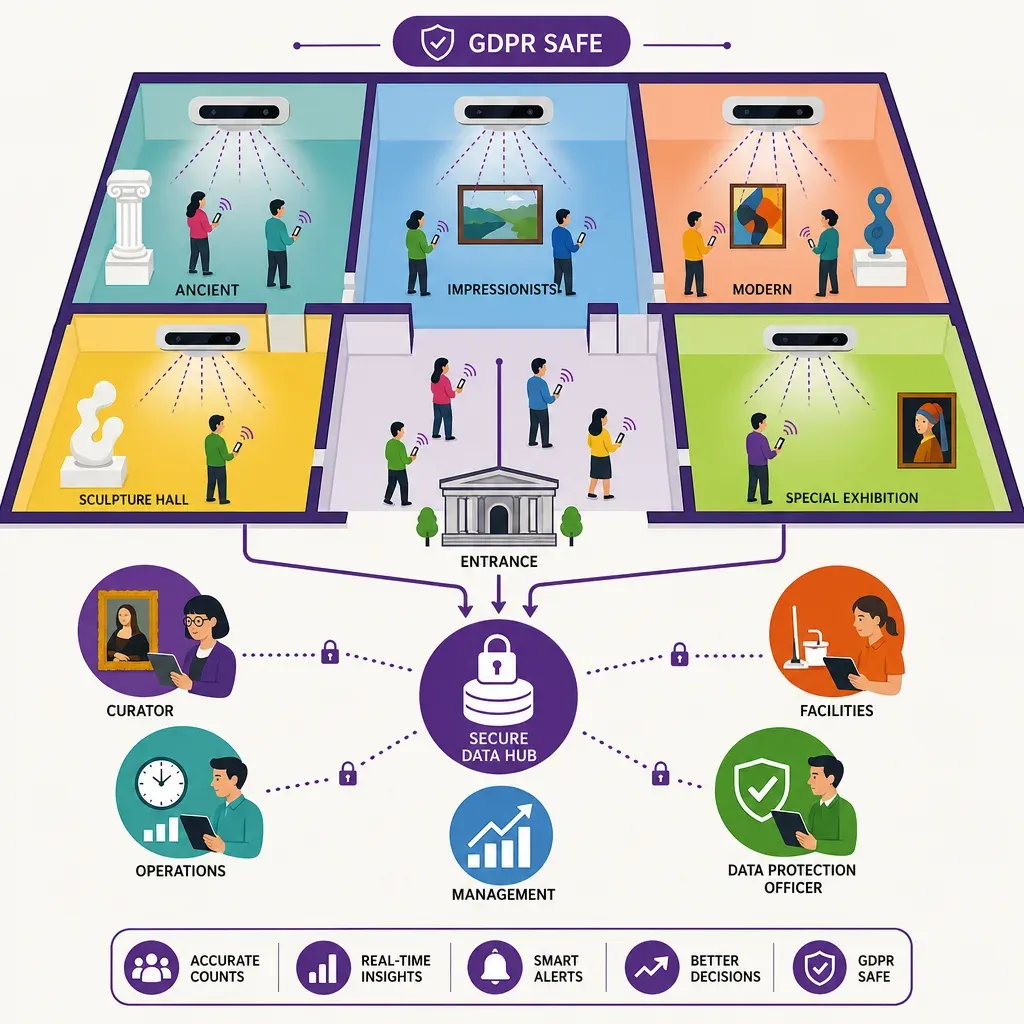
Yes. With sensors placed across the building, each gallery, wing, or temporary exhibition becomes its own zone, with its own entry count, live occupancy, and average dwell time. That per-zone breakdown is what lets a museum judge exhibition performance and manage capacity, rather than knowing only how many people entered the building.


