
The metric cities still under-instrument
Most cities know, to the nearest car, how many vehicles cross a given junction in a day. Inductive loops in the asphalt have logged that figure for decades, and traffic engineers build models on top of it. Cycling is rarely counted with the same rigour. A new bike lane opens, photos are taken at the ribbon cutting, and a year later the question "did anyone use it?" gets answered with a shrug and a manual count over a wet Tuesday. That gap matters: cycling infrastructure is expensive to install, contested at council level, and easy to defund when no one can produce a number. A people counter configured for a cycle path closes the gap. It tells the city, continuously and per hour, how many cyclists are using a given route, how that figure moves across the year, and what a new piece of infrastructure actually changed.
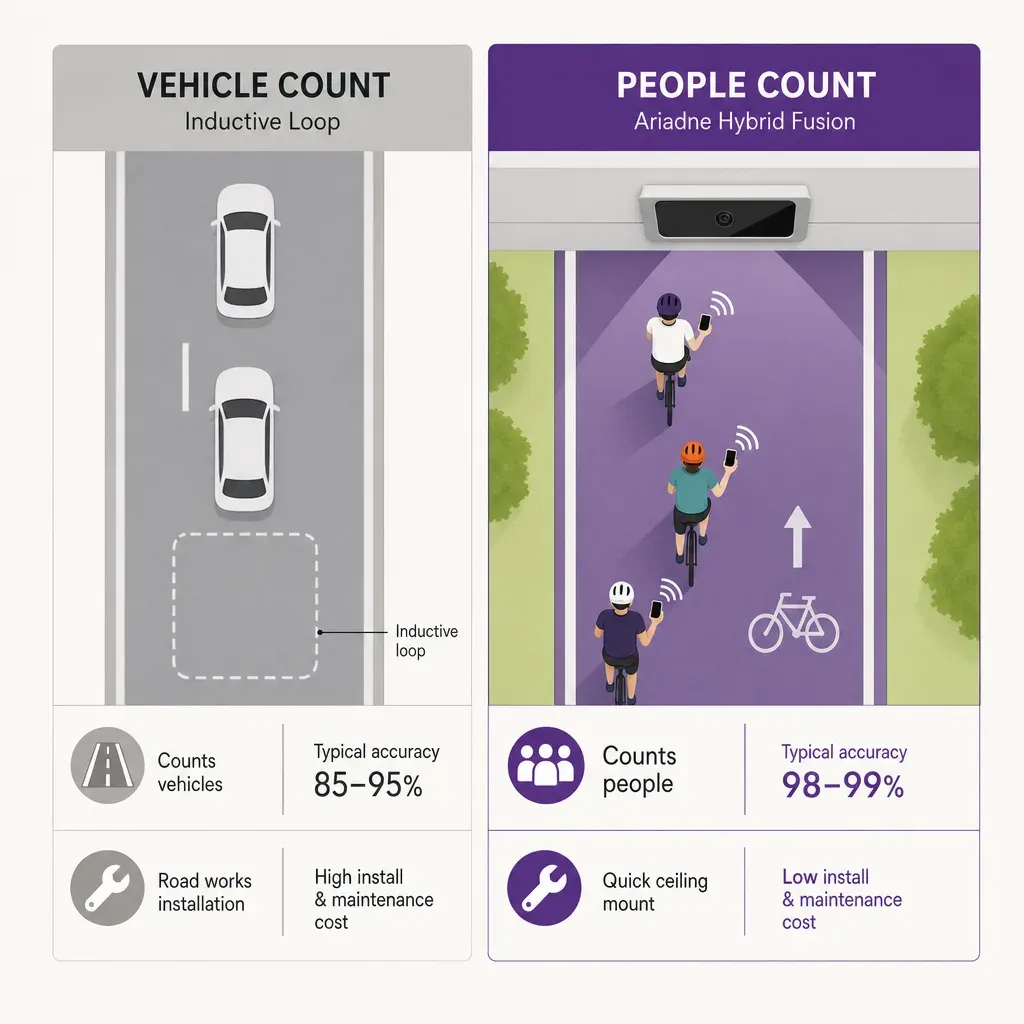
Several European countries have been doing this for years. The Netherlands and Denmark publish national cycling counts. Germany has cycle-counting programmes in many federal states, and German cities increasingly publish dashboards alongside their mobility plans. The technology to count bikes well exists; the question for most other cities is which method to use, where to put it, and what to do with the data once it arrives.
Why measuring cyclists matters for infrastructure spend
A cycle count is not just a vanity figure for a press release. It is the input three different teams need to do their jobs.
Transport planning
Modal split, the share of trips taken by bike rather than car, public transport, or on foot, is a headline number in every mobility plan. Without continuous cycle counts on the main routes, modal split is an estimate built from a household survey every few years. With them, it is a measured figure that updates monthly and reflects what actually changes when a new lane, a junction redesign, or a school-street scheme goes in.
Capital project justification
Cycle lanes compete with parking, bus lanes, and pavement widening for the same kerb space. Council members who vote on those projects want before-and-after evidence. A counter on the corridor before a redesign and the same counter after it gives the team an honest answer: did the new layout increase cycling on that route, by how much, and on which days. Without that, every project becomes an argument from first principles.
Maintenance and safety
Counts also drive maintenance prioritisation. A path carrying ten thousand riders a week needs winter clearing and surface repair before one carrying five hundred. After an incident at a junction, hourly counts give a denominator for the risk: how many cyclists pass the spot per hour at the time of day the incident happened. That changes the question from anecdote to rate.
How cycle counting differs from pedestrian counting
On paper, a cyclist is just another person crossing a line. In practice, the sensing problem is meaningfully different from counting people on a pavement or through a shop door. Four properties shift.
Speed
A walking adult crosses a counting zone at about 1.3 metres per second. A commuting cyclist on a flat path crosses it at roughly four to seven metres per second, and faster on a downhill. That changes the demand on the sensor. The frame rate has to be high enough that a fast rider is captured in multiple samples and never as a single ambiguous blur. A sensor specified for pedestrian doorways without a check on its sampling rate can undercount cycle traffic at peak speed, which is exactly when cycling matters most.
Width of the count zone
A shop entrance is typically a metre or two wide. A two-way cycle path is three to four metres wide, and a shared use path can be wider. Sensors mounted for narrow doorways do not cover those widths. A cycle counter has to cover the full path with overlapping fields of view, or it will miss riders who pass along the verge or who overtake side by side. The install plan has to account for path width before it accounts for anything else.
Weather sensitivity
Cycle paths sit outdoors, under rain, snow, direct sun, low winter light, and the occasional fallen branch. A sensor housing has to be rated for the conditions; in practice, that means IP65 or better and a temperature range that covers the full local climate. Beyond housing, the sensing method itself has to behave through weather. A method that depends on ambient lighting will misread at dusk in winter. A method that depends on heat contrast will struggle on a hot day when the path surface and the rider are at similar temperatures. Time-of-Flight depth sensing is largely immune to both, because it provides its own infrared illumination and reads geometry directly.
Mode separation
On a shared path, cyclists, walkers, scooter riders, and runners all use the same surface. A bare crossing count is the sum of all four, which is rarely the figure the city wants. Useful cycle counting separates modes. Geometry helps here: a cyclist and a bicycle together have a recognisable height-and-shape profile, distinct from a pedestrian or a child. A sensor that reads geometry can be configured to count cyclists as a class, not just objects, and report the mode mix on the path. That separation is what turns a counter into a real mobility tool rather than a generic motion logger.
Camera-free options for cycle paths
Cycle paths run through residential streets, parks, riverside routes, and town squares. A camera array on a lamp post in any of those places will draw complaints, and rightly so. Residents do not want to be filmed on the way to work because the city wants a count. There are two routes around this, and only one of them holds up.
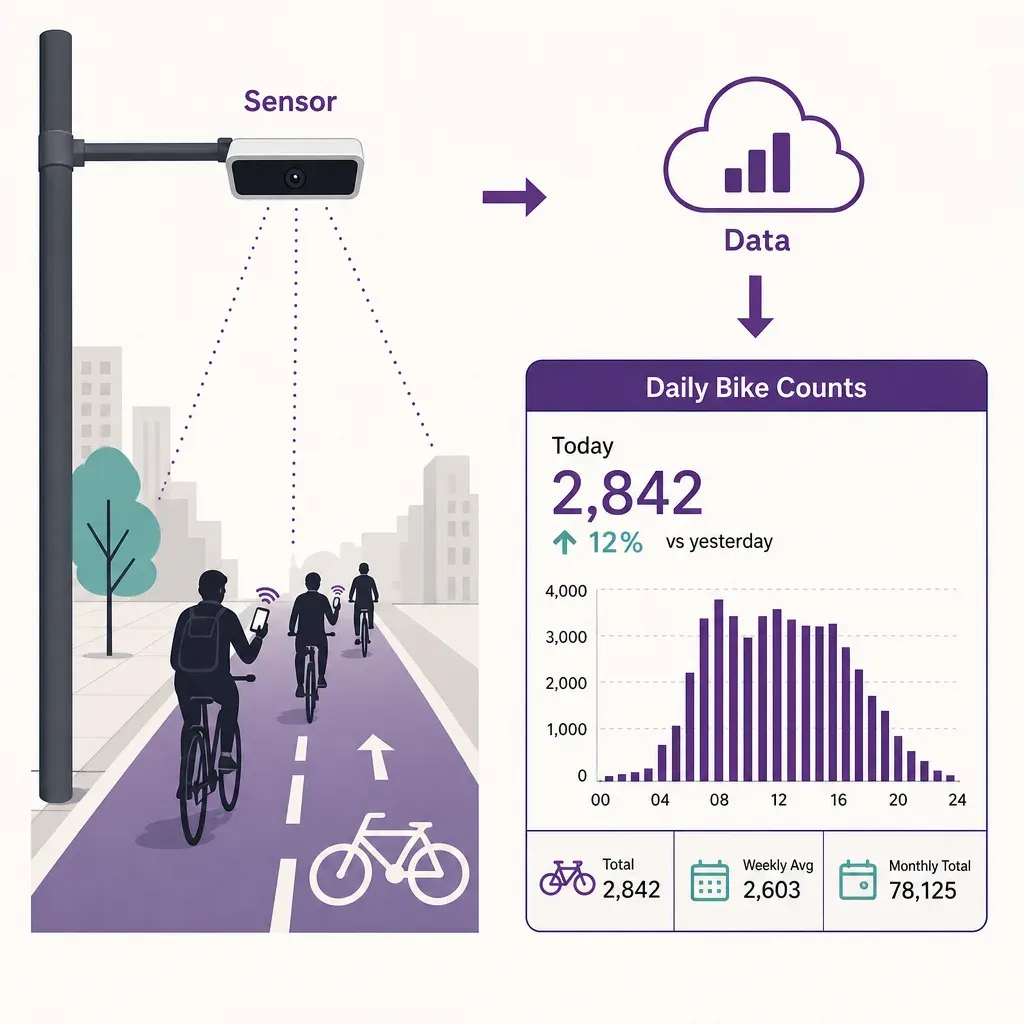
The first route is a camera with on-device blurring or post-processing. The footage is still captured before it is altered, the lens is still pointed at people, and the legal position depends on details a passerby cannot see. It will count cyclists, but it does so at the cost of a visible camera and a privacy story that has to be explained every time someone asks.
The second route is to choose a method that never captures an image in the first place. Time-of-Flight depth sensing is the obvious fit for cycle paths: it fires infrared pulses, measures how long they take to return, and builds a height map of whatever passes underneath, to roughly thirty centimetre accuracy. It counts every rider that crosses the zone, in daylight and after dark, in rain and clear weather. It produces no picture, no face, and no biometric data. There is nothing to redact later because no image of a person is captured to begin with. That is a much shorter conversation with a data protection officer, and a much shorter conversation with a resident who asks why there is a sensor on the path.
Some installations also combine the cyclist count from the path with longer-range mobility signals to understand journey origins and destinations across a city. The sensing for that is described in detail in the how-it-works page, and it follows the same rule as the path counter: no camera, no identifier captured by default.
How Ariadne fits a cycle-counting programme
Ariadne measures this with Hybrid Fusion, its patented camera-free method. Time-of-Flight depth sensing counts every visitor at the entrances, capturing geometry rather than images, while patented phone signal sensing follows movement through the interior, detecting the signals a phone emits even in airplane mode. The sensor streams both feeds to Ariadne, where Hybrid Fusion combines them into one trajectory per visit and computes counts, dwell, and paths. The streams carry no identifier: no MAC address, no device ID, no biometric data, and no camera is involved. Identifiers are stored only when a visitor explicitly opts in, which keeps the method GDPR-friendly and outside biometric territory.
For a city counting bikes, the practical consequences are concrete. The sensor on a cycle path reads geometry through Time-of-Flight depth sensing, with the sampling rate and field of view configured for the higher speeds and wider zones cycle traffic asks for. The same hardware family covers indoor and outdoor public-space deployments, which keeps the procurement and maintenance simple when a city is counting more than one mobility mode. The streams carry no MAC address by default and no device identifier, so the count is a count, not a tracked journey, unless a rider opts in for a service that needs more. The hardware options sit in the Ariadne sensor lineup, and the data handling is set out in the privacy policy.
Several German cities work with Ariadne on public-space measurement of this kind. The deployments are camera-free by design and produce the same continuous counts a transport team would expect from a vehicle loop, but for cyclists and pedestrians, and without the surveillance footprint a camera would impose on the street.
A procurement checklist for a cycle-path counter
If a city or a transport authority is putting a cycle-counting programme together, these are the questions worth asking any vendor in writing before a pilot.
- Does the sensor cover the full width of the path? Confirm the field of view covers a two-way lane or a shared path end to end, with no edge misses, at the mounting height the site allows.
- What is the maximum counted speed? Ask for the highest rider speed at which the system maintains accuracy. A pedestrian-grade frame rate is not enough for downhill cycle traffic.
- How are cyclists separated from pedestrians and scooters? On any shared path, a single crossing count is the wrong figure. Confirm the system reports the mode mix, not just a total.
- What happens in rain, snow, and low light? Ask for the weather rating of the housing and the behaviour of the sensing method through dusk, night, and precipitation. A method with its own infrared illumination, like Time-of-Flight, does not depend on the weather to count.
- Is there a camera anywhere on the path? If the answer is yes, expect the privacy conversation to run every year. A camera-free method removes the question.
- How does the data export into the city's existing tools? Transport teams already work with vehicle and pedestrian data in their own systems. Counts that export cleanly into those tools, by hour and by day, get used. Counts trapped in a vendor portal do not.
FAQ
Does a cycle path counter use a camera?
No. Ariadne counts with Hybrid Fusion: Time-of-Flight depth sensing plus patented phone signal sensing, never cameras. Time-of-Flight captures geometry rather than images, and signal sensing captures no MAC address by default, so the measurement involves no video, no faces, and no biometric data.
Can one sensor count both cyclists and pedestrians on a shared path?
Yes, if the sensor reads geometry rather than motion alone. A Time-of-Flight depth sensor sees the height and shape of whatever crosses the zone, which lets the system classify a cyclist plus bicycle separately from a walking adult, a child, or a scooter rider. The path reports a mode mix rather than a single total, which is the figure a transport team can actually use.
How accurate is a camera-free cycle counter compared with a manual count?
Accurate to roughly thirty centimetres on position, with consistent counts through day and night and across weather. Manual counts are accurate for the hour they are taken and then they stop. The honest comparison is not accuracy at a single moment but coverage across the year: a sensor produces eight thousand seven hundred and sixty hours of count a year, a manual count produces a handful of those, and the city's decisions are about the year, not the hour.
What about winter, when cycling volumes drop?
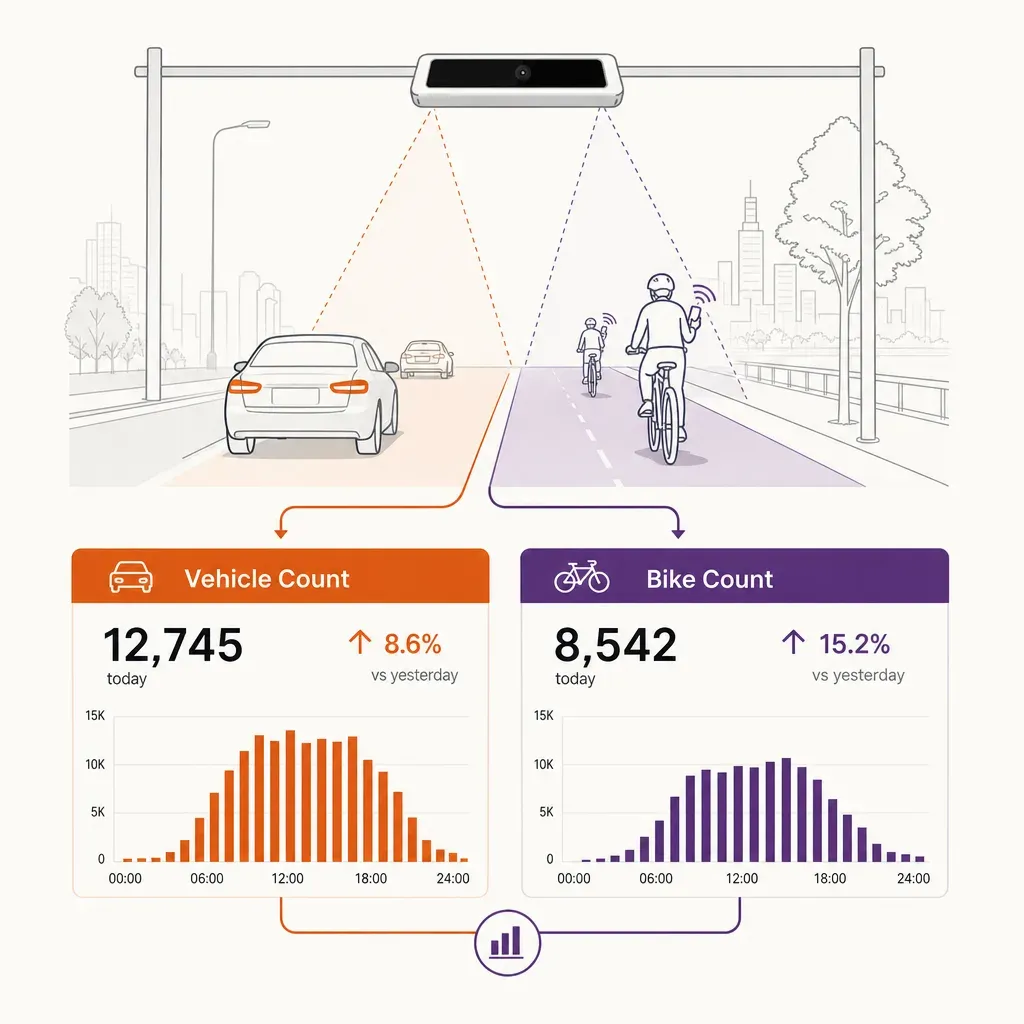
Winter is exactly when continuous counting earns its keep. A drop in cycling volumes is a piece of information: it tells the city how weather-elastic a given route is, which routes hold ridership through cold months, and which need a clearing priority to keep cyclists on them. Without continuous counts, that pattern is invisible until someone notices, by anecdote, that the path looks empty.


