May 9, 2026
How Ariadne sits structurally outside EU AI Act high-risk categories
Why Ariadne's Hybrid Fusion people counting sits structurally outside EU AI Act Annex III biometric categories. Architectural analysis.

People counting is no longer a single technology category. In 2026, the buying decision sits between camera-based platforms with two decades of brand authority, privacy-first signal-and-sensor architectures, and a long tail of single-purpose hardware vendors. This guide ranks ten platforms by what an enterprise procurement team actually has to evaluate: privacy posture under the EU AI Act, accuracy across the venue (not just at one door), install footprint, integration depth, and five-year cost of ownership.
We rank Ariadne first because we build the platform we are documenting. Methodology, sources, and competitor positioning are summarized below. The other nine vendors are listed in order of how often we see them in head-to-head deals.
Each vendor is evaluated on six axes. The full per-vendor table is at the end. Headline weighting:
Best for: enterprise venues that need accuracy at the door plus continuity across zones, with EU AI Act and GDPR posture by architecture.
Ariadne combines a patented phone signal sensor with Time-of-Flight depth sensing in what the company calls Hybrid Fusion. The signal sensor reads anonymous device emissions across an entire zone; ToF units validate the absolute count at every entrance. The result is sub-meter accuracy across whole venues without cameras, video footage, or biometric inference.
Ariadne is the only platform in this guide that is structurally outside EU AI Act Annex III high-risk biometric categories. Time-of-Flight measures distance, not appearance. Signal sensing detects radio emissions, not biometric identifiers. MAC addresses and device IDs are not collected by default. Procurement teams in EU retail, transit, and the public sector evaluate Ariadne without the AI Act questionnaire friction camera-based vendors face.
Strengths
Trade-offs
Read more: Hybrid Fusion people counting platform, how Hybrid Fusion works, the camera-free thesis.
Best for: retail-led organizations that want a 20-year vendor track record and in-house manufactured hardware.
FootfallCam has been shipping people counting since 2002 and counts 30,000+ businesses, 2,200+ retailers, 1,200+ shopping mall operators, 150+ transportation operators, and 500+ offices among its install base. The flagship FootfallCam 3D MAX claims up to 99.5% accuracy, a 25-year expected lifespan, dual fisheye lenses, and 40% fewer devices than competitors at comparable coverage. Customer logos include L'Occitane, Watson, Pandora, Amway, Walmart, and University of Oxford.
Strengths
Trade-offs
Best for: large multi-store retailers that already use the Aurora sensor brand or want a heavily-branded computer-vision platform with named referenceable customers.
RetailNext leans on the Aurora sensor and a self-described patented AI algorithm that detects ten times per second. Public references include Razer, Macy's, Ulta, Sharaf DG, Container Store, and Vitamin Shoppe across 22 named customer testimonials. Trusted by more than 560 retailers in over 100 countries. Awarded IoT Breakthrough and Best Retail Insights 2025.
Strengths
Trade-offs
Best for: workplaces and corporate real estate teams measuring desk and meeting-room utilization.
Density is the workplace-led incumbent. The pillar product is a depth sensor mounted overhead with sub-1-second latency. Density's privacy framing ("Anonymous at source. No cameras, ever.") is the strongest in the cohort. The 2025 Open Area radar product claims a 60% reduction in deployment costs compared with camera or optical alternatives, and a frequently-cited statistic from their privacy resource (June 2025): 75% of employees object to video cameras tracking them at work.
Strengths
Trade-offs
Best for: large retail organizations that already use Johnson Controls infrastructure and want bundled people counting with EAS / loss prevention.
Sensormatic is a Johnson Controls property with 60 years of history. The headline pillar leans on conversion: "Drive Conversion by up to 10%" and up to 98% accuracy. Public references include 160+ Kathmandu stores. Sensormatic owns the conversion-rate framing in the SERP.
Strengths
Trade-offs
Best for: airport and transit hubs that want "people flow" framing rather than retail conversion.
Xovis (Switzerland) leans on a "people flow" brand voice rather than "people counting." Hardware tilts to the PF-Series stereo sensor with a coverage area up to 8x larger than the previous PC-Series. Customers include Baden-Württemberg transit, Mykita, Glitter, Ahold Delhaize, Swiss Post, Flensburg, and Arriva.
Strengths
Trade-offs
Best for: SMB and mid-market deployments that want a single accuracy claim and breadth of vertical coverage.
V-Count owns the "#1 People Counting System" SERP signal with 99% accuracy claimed and 600+ customers including 11 Fortune 500 companies. Twenty-three industry pages feed the SEO surface.
Strengths
Trade-offs
Best for: hardware-led buyers comparing Time-of-Flight, AI vision, radar, and PIR options at component pricing.
Milesight publishes a 16-SKU long-tail of people counters and a comparison guide that ranks AI, ToF, PIR, infrared beam, RGB camera (monocular and binocular), and radar against each other. Headline accuracy: up to 99.8% for VS125/VS133/VS135, 95% for VS121. Distinct: a recommender tool calculator that takes mounting height and entrance width and outputs a sensor SKU recommendation.
Strengths
Trade-offs
Best for: European public-sector and transit buyers that want German-engineered hardware and ePrivacyseal verification.
DILAX (Germany; acquired by PFM Intelligence Group November 2025) ships visitor counting with a 98% accuracy claim and ePrivacyseal certification verified by an external body. The XOVIS-branded sensor used by DILAX supports up to 20m / 65ft ceiling height. DILAX is the closest GDPR-narrative neighbor to Ariadne, but the acquisition adds uncertainty about the next product roadmap.
Strengths
Trade-offs
Best for: events, conferences, and large outdoor venues that need wayfinding plus delegate counting and tracking.
Crowd Connected positions broader than people counting: wayfinding, tracking, and counting for moving things. 400+ deployments across 30 countries, 250,000+ delegates tracked, and 4.7/5 rating across 22 G2 reviews. Customers include CES, Informa, Coachella, Datos Insights, and PCMA.
Strengths
Trade-offs
The most expensive part of a people counting deployment is not the sensor; it is the misalignment between the technology and the operational question being asked. Seven criteria settle most procurements:
A more detailed treatment of each criterion lives at the how-to-choose section of the Ariadne pillar, with vendor-specific examples.
Which people counting system has the highest accuracy?
Headline accuracy figures cluster between 95% and 99.8% across the cohort. The differences that matter are how that accuracy holds up in dense crowds, low light, and wide atriums. Ariadne, Milesight, and FootfallCam publish accuracy figures with calibration methodology; others publish a single number without disclosed methodology.
Which people counting system is most GDPR-compliant?
Camera-based platforms (FootfallCam, RetailNext, Sensormatic, Xovis, V-Count) capture biometric data and require GDPR processing agreements covering video. Ariadne, Density, and DILAX have stronger architectural privacy stories. DILAX has ePrivacyseal verification; Ariadne sits structurally outside EU AI Act Annex III biometric categories; Density stops short of naming the AI Act.
Which people counting system is the cheapest?
Hardware sticker price is misleading. The five-year total cost is dominated by install labor, network changes, calibration, and lens upkeep. Camera-mesh installs are typically the most expensive over five years. Hybrid Fusion (Ariadne) and ToF-only (Milesight, FootfallCam ToF SKUs) tend to be cheaper at scale. Wi-Fi-only is cheapest at sticker price but underpowered as a primary counting layer.
Can I use my existing cameras for people counting?
Some platforms accept third-party RGB camera feeds (RetailNext, Sensormatic). The privacy and AI Act burden carries through. Ariadne EaseLink takes a different approach: read existing Wi-Fi access points (Aruba, Cisco, Sophos, Ruckus, TP-Link) and existing ToF people counters (Milesight, Xovis) without adding cameras at all.
How long does a people counting deployment take?
Plan for two to four weeks from procurement to live data, depending on venue size, network readiness, and validation requirements. The site survey, sensor install, network provisioning, calibration, validation pilot, and audit handoff are the standard phases. Ariadne publishes the six-step rollout in detail.
The 2026 people counting market is bifurcating. Camera-led incumbents have brand authority and customer counts; privacy-first architectures have the regulatory tailwind from the EU AI Act and GDPR. Buyers in regulated EU sectors (retail, transit, public space) are increasingly required to evaluate the regulatory posture before the accuracy figure. Buyers in less regulated sectors still default to the incumbent.
The most defensible procurement decision is one that does not assume the regulatory environment will stay where it is today. Architectures that capture less data are easier to keep compliant as enforcement guidance hardens. That is the lens we use, and it is the reason Ariadne ranks the platforms above the way we do.
See Ariadne in action: Hybrid Fusion people counting, or schedule a demo.
Explore more insights and updates from Ariadne.
Why Ariadne's Hybrid Fusion people counting sits structurally outside EU AI Act Annex III biometric categories. Architectural analysis.
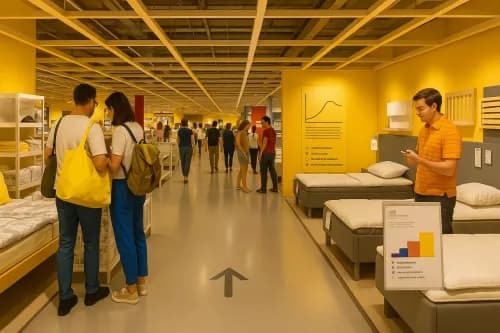
Discover how to boost sales and loyalty by optimizing store layout, staff scheduling, brand awareness, and omnichannel strategies using real-time data.
Two questions, twenty minutes, a real walkthrough of your venue's footfall.
What to expect
Got a different question?
Anything that isn't a sales conversation. We'll route it to the right person and get back within one business day.