
The question every branch network is asking
Retail banking has spent the past decade moving online. Customers open accounts, move money, and check balances on a phone, and the branch is no longer where most everyday banking happens. That shift leaves every regional manager with the same hard question: which branches still earn their place, which need to be smaller, and which should close? Answering it well takes more than transaction volume and account counts. It takes a clear read on who is actually walking through the door, when, and what they come in to do. That is what branch footfall counting measures, and it is the missing input in most branch network reviews.
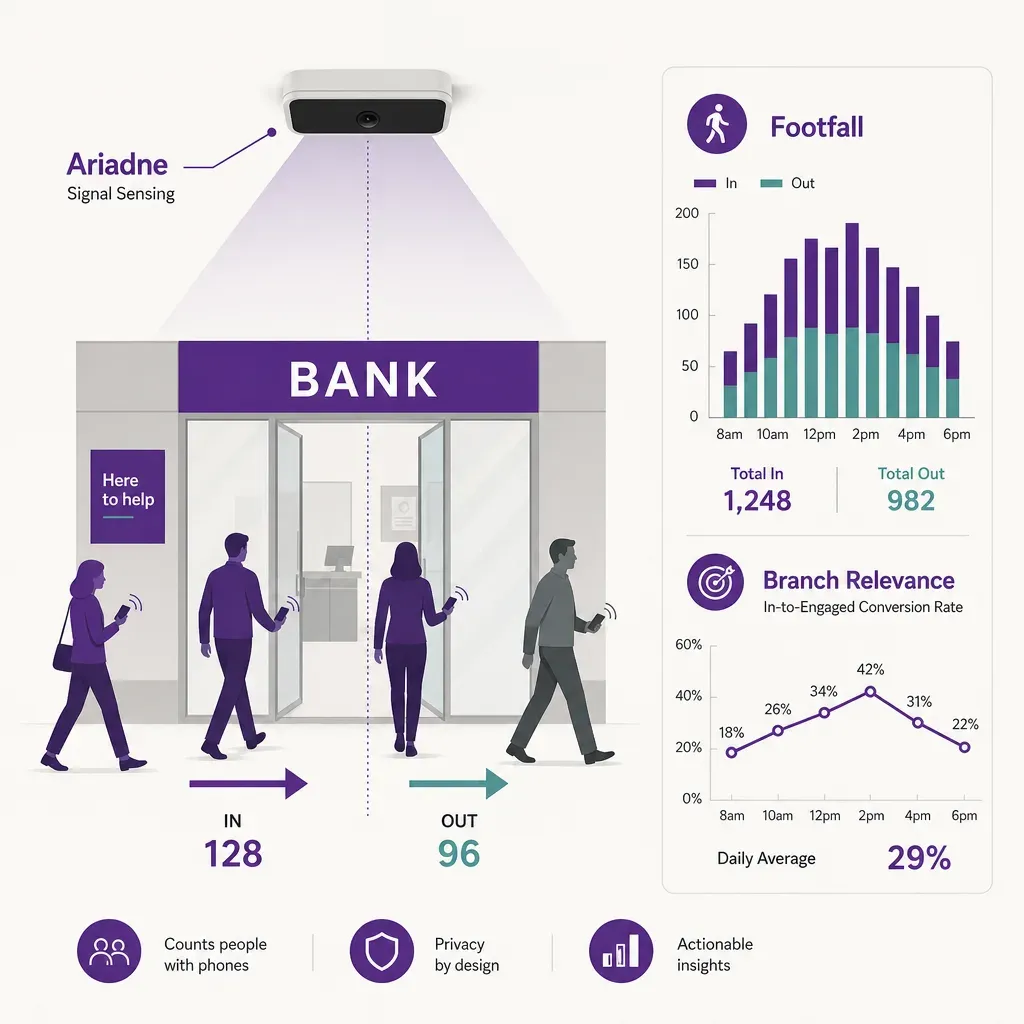
Footfall is not a vanity figure. It is the difference between cutting a branch that looks quiet on paper but anchors a high-value customer base, and keeping one that feels busy but mostly sees people using the ATM lobby. A branch network runs on real estate, staff rosters, and security, all of which are expensive and slow to change. Footfall data turns those decisions from instinct into something a finance committee can sign off.
Why transaction data is not enough
Most banks already have a great deal of data about a branch: accounts held, transactions processed, products sold, appointments booked. That data is valuable, but it has a blind spot. It only records people who completed something the system logged. It misses everyone who walked in, looked at the queue, and left. It misses the customer who came in for advice, could not find a free adviser, and went home to call the contact centre instead. It misses the foot traffic in the lobby that never reaches a teller at all.
Footfall counting fills that gap. It records every visit, not just the visits that ended in a logged transaction. The comparison between visits and completed actions is where the useful signal lives:
- High footfall, low transactions. A branch people walk into but rarely complete anything in. That can point to slow service, missing staff, or a layout that sends customers back out the door. It is a fixable problem, not a reason to close.
- Low footfall, high value. A quiet branch that handles a small number of high-value relationships. Visit counts alone would mark it for closure, but the customer base behind it may be worth far more than the rent.
- Steady footfall, falling transactions. People still come in, but increasingly for things that no longer need a branch. That is a candidate for resizing or repurposing, not closing.
None of those patterns is visible from transaction data on its own. You need the denominator: how many people came in, against how many did something the bank could record.
Staffing to demand instead of to a fixed roster
Branch staffing tends to follow habit rather than demand. A branch is rostered the same way every week because that is how it has always been rostered, even though traffic has clear peaks and troughs across the day and the week. Footfall data, broken down by hour and day, lets a branch manager match staff to the times people actually arrive.
The pattern is usually obvious once you can see it. For example, a branch might see a sharp lunchtime peak on weekdays and a second smaller peak late on a Thursday or Friday afternoon, with long quiet stretches mid-morning. Those are illustrative figures, not measured results, but the shape is common: rostering more advisers across the peaks and fewer through the troughs improves service at the busy times and saves payroll at the quiet ones. The same hourly data flags when a branch has too many staff for the traffic it sees, which is a closure or downsizing signal that transaction counts hide.
Queue load and teller load are different problems
A single door count tells you a branch was busy. It does not tell you where the pressure landed. In a branch, two distinct things can go wrong, and they call for different fixes.
- Queue load. How many people are waiting, and for how long. A long queue at the teller line is a service problem the customer feels immediately, and it is the moment a frustrated visitor decides to bank elsewhere. Measuring how queues build across the day shows whether the issue is a staffing gap at known peaks or a layout that funnels everyone to one counter.
- Teller and adviser load. How busy the people serving customers actually are. A branch can have a long queue while advisers sit idle because customers are routing to the wrong place, or it can have light queues but advisers stretched thin on long appointments. Separating the two tells a manager whether to add tellers, add advisers, or change how customers are triaged at the door.
Reading queue length and waiting time needs more than a count at the entrance. It needs the system to resolve how many distinct people are standing in a given area and how long they stay there. That is a job for sensing that can tell individuals apart inside the branch, not just tick a counter as someone crosses the threshold.
Deciding which branches to keep, resize, or close
A branch network review is one of the highest-stakes decisions a retail bank makes. Closing the wrong branch loses customers and draws local press; keeping the wrong one bleeds cost for years. Footfall data does not make the decision on its own, but it gives the review a defensible factual base alongside transaction and revenue data.
Read together, footfall and existing branch data support four moves:
- Keep. Strong, steady footfall, healthy completed-action rate, and a customer base that values the location. The numbers back the lease.
- Resize. Footfall that no longer fills the floor space, or traffic concentrated in a self-service lobby. A smaller format or a relocation to a cheaper unit fits the demand without losing the catchment.
- Fix. Healthy footfall but weak conversion to completed actions, which points to service or layout rather than location. Worth investment before any thought of closing.
- Close. Falling footfall, low completed actions, and a customer base that can be served from a nearby branch or digitally. The hardest call, made far more confidently with visit data behind it.
The same data supports the reverse case too. When a network is choosing where to invest in a flagship or a refurbished branch, footfall by location and time shows where the demand actually concentrates.
The privacy bar in a bank branch
A bank is held to a higher standard on data than almost any other business, and customers expect it. Putting cameras on people in a branch to count them runs straight into that expectation, and into the law. Under the GDPR, images of identifiable customers are personal data, and facial recognition produces biometric data, a special category that is hard to justify for a headcount and that no compliance team wants to defend. A counting system that records who people are, even incidentally, becomes one more sensitive data store the bank has to secure, audit, and answer for.
The clean way past that is not to soften a camera feed after the fact. It is to choose a method that never captures identifying data in the first place. There is nothing to anonymise later because nothing identifying was collected to begin with, which keeps footfall counting well clear of the bank's most sensitive data obligations.
How Ariadne measures branch footfall
Ariadne counts branch footfall without a camera and without capturing anything that identifies a customer.
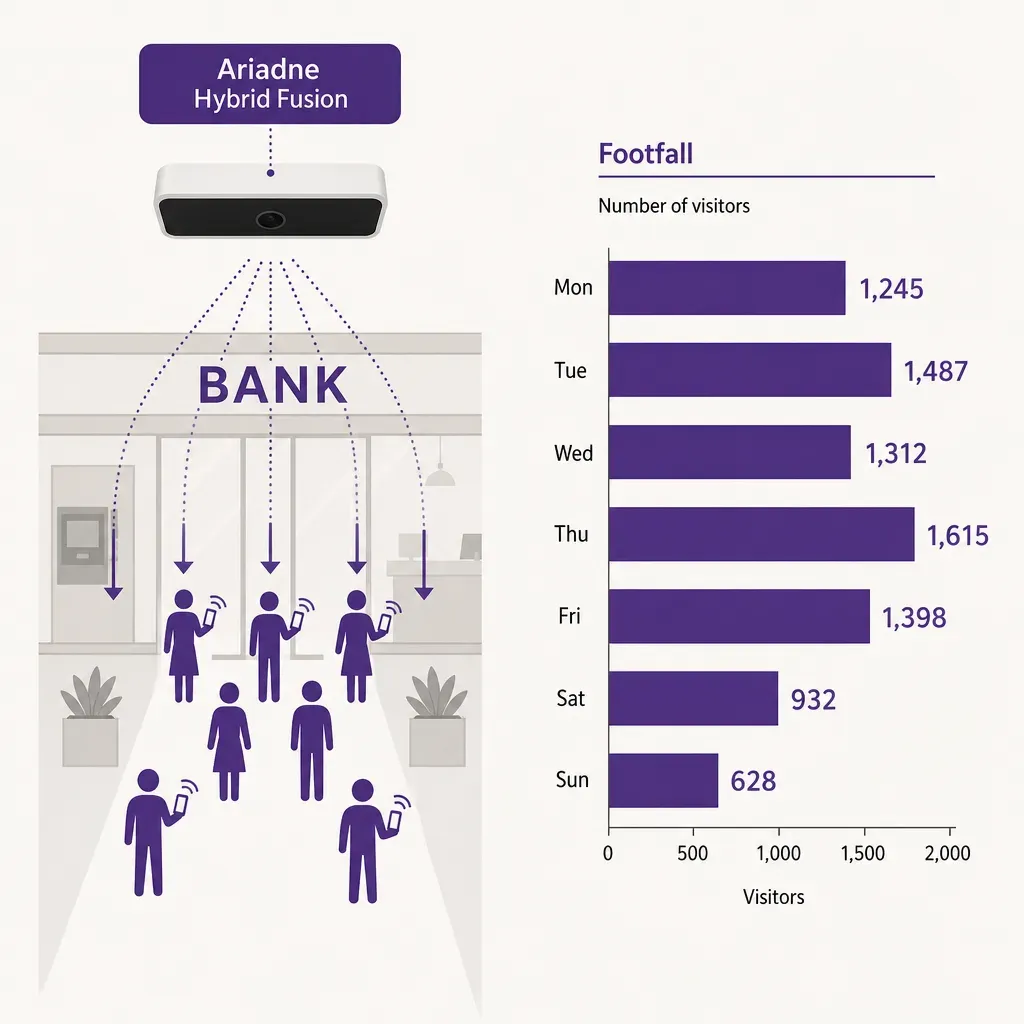
Ariadne measures this with Hybrid Fusion, its patented camera-free method. Time-of-Flight depth sensing counts every visitor at the entrances, capturing geometry rather than images, while patented phone signal sensing follows movement through the interior, detecting the signals a phone emits even in airplane mode. The sensor streams both feeds to Ariadne, where Hybrid Fusion combines them into one trajectory per visit and computes counts, dwell, and paths. The streams carry no identifier: no MAC address, no device ID, no biometric data, and no camera is involved. Identifiers are stored only when a visitor explicitly opts in, which keeps the method GDPR-friendly and outside biometric territory.
For a branch, that combination does the work the sections above describe. Time-of-Flight depth sensing at the door counts every person who enters, independent of whether they carry a phone, by reading geometry rather than images. Patented phone signal sensing inside the branch resolves how many distinct people are present in an area and how long they stay, which is what turns a raw door count into queue length, waiting time, and dwell at the teller line. The streams carry no MAC address by default and no device identifier, so there is no personal data in the count, and identifiers are stored only when a customer explicitly opts in, for example through a guest Wi-Fi login the bank can simply choose not to offer. The sensor hardware sits in the Ariadne sensor lineup, and the data handling is set out in the privacy policy.
A buyer checklist for branch networks
If you are evaluating a footfall system for a branch network, these are the questions worth putting to any vendor in writing before a trial.
- Does it capture any personal data? Ask whether the system records images, faces, MAC addresses, or device identifiers. You want a clear no by default, with any identifier limited to explicit opt-in. In a bank, this is the first question, not the last.
- Is there a camera anywhere in the path? A method built on Time-of-Flight depth and signal sensing avoids cameras entirely, which is the cleanest answer to give a compliance team and a data protection officer.
- Can it measure queues and waiting time, not just the door? For staffing and service decisions you need to resolve how many people are waiting and for how long, which takes more than a count at the entrance.
- Does it break footfall down by hour and day? Staffing to demand needs the hourly and daily pattern, not a single weekly total.
- Does it report live occupancy? Real-time numbers let a manager react during the day rather than read a report the next morning.
- Will the figures stand up in a network review? Footfall data should export cleanly into the same reports your property and finance teams use to decide which branches to keep, resize, or close.
FAQ
Does the system use cameras?
No. Ariadne counts with Hybrid Fusion: Time-of-Flight depth sensing plus patented phone signal sensing, never cameras. Time-of-Flight captures geometry rather than images, and signal sensing captures no MAC address by default, so the measurement involves no video, no faces, and no biometric data.
Is footfall counting in a bank branch GDPR-compliant?
It can be, and the reason is straightforward: a method that captures no images, no faces, and no device identifiers by default is not processing personal data, so the heaviest GDPR obligations do not attach to it. That is a stronger position than blurring a camera feed, because there is nothing identifying captured in the first place. Confirm the specifics with your own data protection officer, but a no-personal-data design is the easiest case to make in a bank, where the compliance bar is already high.
Can it measure queues and waiting times, not just entries?
Yes. A door count alone only tells you a branch was busy. By resolving how many distinct people are present in an area and how long they stay, the system reports queue length, waiting time, and dwell at the teller line, which is what staffing and service decisions actually depend on.
How does footfall help decide whether to keep or close a branch?
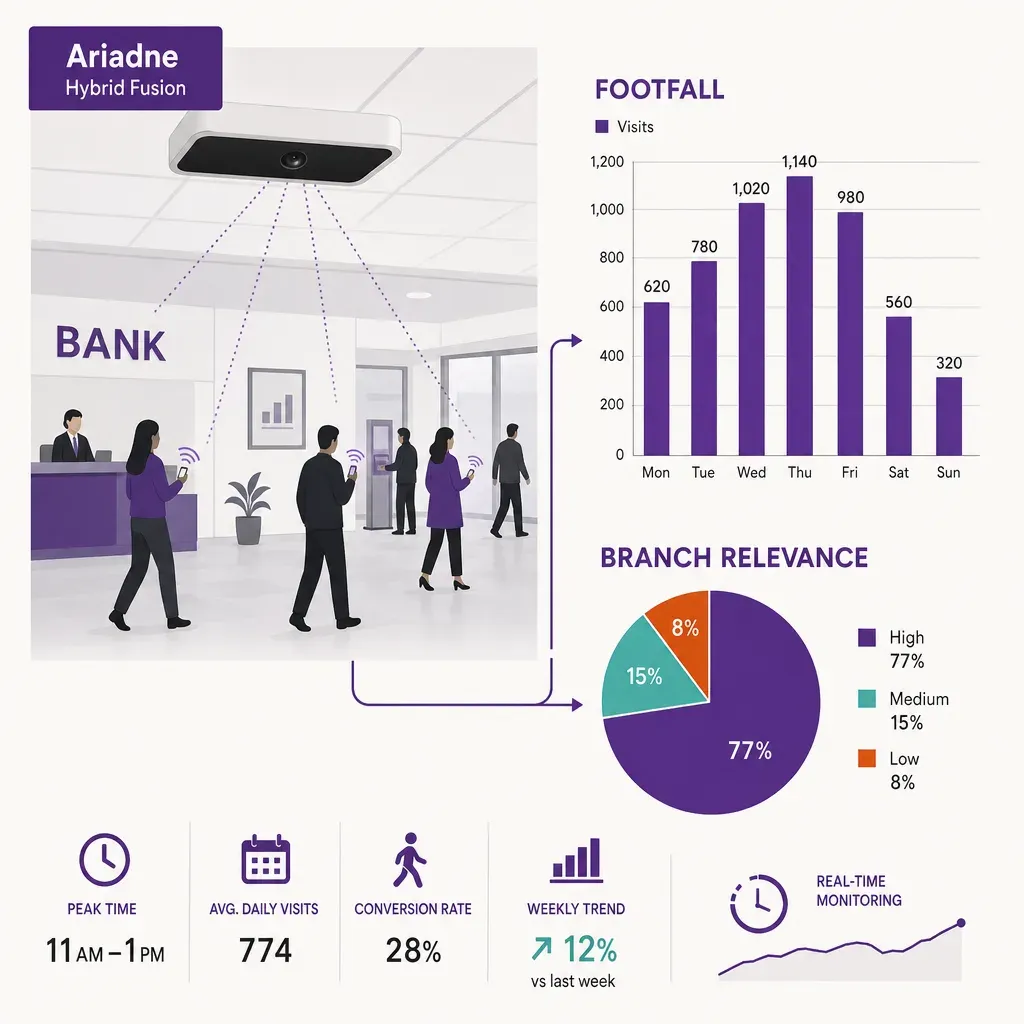
Footfall gives you the denominator that transaction data lacks: how many people came in, against how many completed something the bank could record. Read alongside revenue and customer value, that comparison separates a branch worth fixing from one worth resizing or closing, and gives a network review a defensible factual base rather than instinct.


